
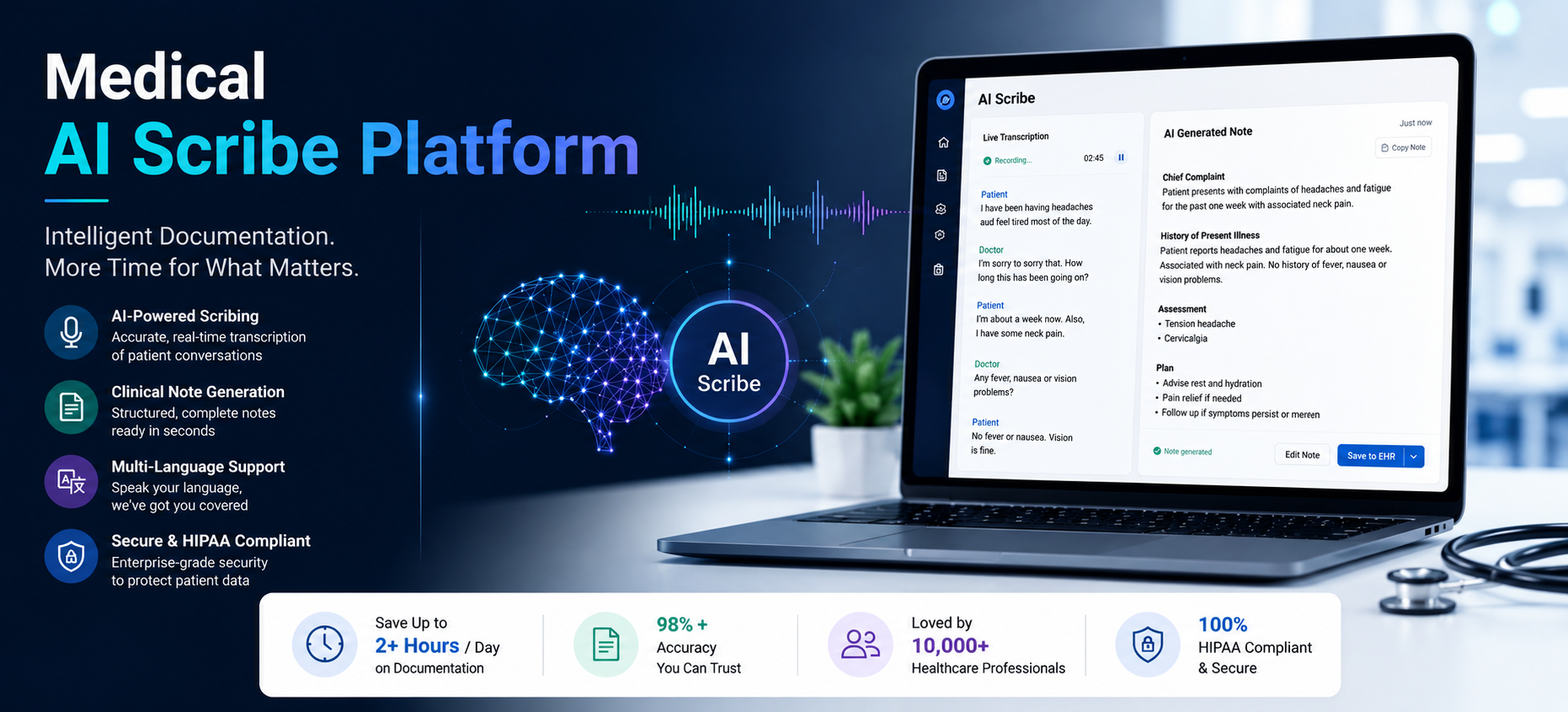
Dr. Ananya finished her last OPD patient at 6:15 p.m. — and her real work began. Forty-seven consultations meant forty-seven EMR notes, each requiring history, examination findings, assessment, and plan typed by hand while dinner went cold. Across India and the GCC, this invisible second shift is the largest hidden cost in outpatient care. AI medical scribe software is finally changing that story.
"My patients thought I was checking my phone during the visit. I was dictating into three different apps that still did not land in our HIMS."
— Consultant physician, 120-bed hospital, Bengaluru
This kind of frustration is why AI in healthcare conversations have shifted from "should we adopt this" to "how do we pilot it without disrupting care." Ambient clinical documentation isn't a novelty anymore — it's a practical way to draft structured notes during or right after a consultation, with the doctor reviewing every line before it becomes a permanent record.
How AI Voice Medical Documentation Works for Doctors
Modern AI scribes combine speech recognition with clinical language models trained on medical terminology — drug names, investigations, regional accents, and code-switching between English and Hindi or Arabic in GCC clinics. During a consultation, with patient consent, the system listens ambiently. After the visit, it drafts sections mapped to your EMR templates: history, examination, assessment, plan.
The clinician remains in control. Review, edit, approve — then push to CSoft HIMS or your connected EMR. That human-in-the-loop design matters for accuracy, medico-legal compliance, and trust.
What an AI Medical Scribe Pilot Should Cover
Because this kind of build is scoped per hospital rather than sold off-the-shelf, the right question isn't "does the software have feature X" — it's "what should our pilot include." A well-scoped pilot for AI medical scribe software typically covers:
- Speech-to-text capture — capturing doctor-patient conversations as text, with accuracy targets agreed for your specialties and consultation style
- Medical text structuring — extracting complaints, findings, and medications from raw transcripts
- Draft clinical notes — generating notes in formats your clinicians already use, such as SOAP, with every draft reviewed by the doctor before it enters the record
- Multi-language scope — English, Hindi, and regional languages, scoped to where your clinicians and patients actually work
- EMR / HIMS integration — approved notes flowing into your existing system, with integration scope defined during a workflow study
- Specialty templates — note formats built for the departments included in the pilot
- Voice commands — optional hands-free controls for starting capture or navigating notes
- Privacy and audit controls — encryption, audit trails, and the data privacy requirements that apply to your environment
Specialty-Wise Use Cases for AI Medical Scribe Software
Documentation needs change a lot by department, which is exactly why specialty templates matter more than one generic note format. A few patterns hospitals commonly scope into early pilots:
- General medicine and diabetology — high consultation volume and repetitive history-taking make this the most common starting point for a pilot.
- Paediatrics — notes often need a parent or caregiver's reported history alongside the child's symptoms, which the system needs to capture and label correctly.
- Orthopaedics — examination findings are usually structured around specific joints, range of motion, and imaging references, which benefits from a dedicated template rather than a general SOAP format.
- Telemedicine and virtual consultations — often the weakest point for documentation quality, since the doctor is managing a screen, a patient, and notes at the same time. This is also where AI voice medical documentation for doctors tends to show the clearest time savings.
Most hospitals don't try to cover every department in one pilot. Picking one or two specialties with consistent consultation patterns makes it easier to tell whether an AI scribe for hospital outpatient department setup is actually working before expanding further.
How AI Medical Scribe Reduces Doctor Workload
Hospitals piloting AI-assisted clinical note generation hospital software report doctors closing charts before leaving clinic — not batching notes at 10 p.m. Complete, timely documentation improves continuity of care, supports billing accuracy, and reduces the administrative load that drives physician burnout and attrition. These are the kind of medical staff efficiency tools that pay back in retention as much as in time saved.
From an operational view, better documentation also strengthens insurance audits, quality reporting, and referral letters. Documentation quality is revenue and reputation, not just compliance — which is exactly why hospitals want to see real numbers from a pilot before scaling anything hospital-wide.
Where AI Medical Scribe Fits in a Broader Healthcare Automation Roadmap
Clinical documentation rarely sits in isolation. As hospitals invest in healthcare automation more broadly, AI scribe pilots often sit alongside other forms of healthcare AI automation — robotic process automation for back-office workflows, agentic automation handling multi-step administrative tasks, and clinical decision support systems that surface relevant guidance during a consultation. None of these need to launch together, but scoping a scribe pilot with this bigger picture in mind makes later phases easier to plan.
Integrating AI Scribe with Your HIMS Ecosystem
Standalone dictation creates another silo. Effective deployments route scribe output into the hospital's source-of-truth EMR. CSoft AI Medical Scribe is designed to work inside the CSoft ecosystem — capturing consultations and populating structured notes without breaking the doctor's rhythm.
Pair with telemedicine for virtual visits where documentation is often weakest, and with voice agents for pre-visit intake that feeds the same patient record.
AI Scribe Software for Hospitals: 2025–2026 Adoption Patterns in India and the GCC
High-volume OPD departments lead pilots — general medicine, diabetology, orthopaedics. Success metrics are simple: minutes saved per consultation, note completion same day, doctor satisfaction scores. Scale by department once outcomes are measured, not promised.
- Run a four-week pilot in one clinic with defined templates
- Measure time-to-note and edit rate per speciality
- Train on review-and-approve workflow, not passive autopilot
- Expand to IPD nursing notes and discharge summaries in phase two
AI Medical Scribe for GCC Healthcare: Compliance Considerations
For an AI medical scribe GCC healthcare deployment, data handling has to be designed around the regulatory environment from day one — not bolted on afterward. In India, that typically means alignment with ABDM, NABH accreditation standards, and the DPDP Act for patient data handling. In the UAE and wider GCC, it means designing around MOH, DOH, or DHA requirements depending on emirate, along with NABIDH and Malaffi data-sharing frameworks where applicable. These aren't optional checkboxes — they shape how consent, storage, and audit trails get built into the pilot from the start.
How CSoft Approaches an AI Medical Scribe Pilot
This is built as a custom extension on CSoft's existing HIMS and Telemedicine foundation, not a generic AI tool dropped into your workflow. The approach is workflow-first: a study of how your clinicians actually consult and document, a defined pilot scope with a small group of doctors, and physician review built into the design from day one. Documentation support can pair with telemedicine for virtual visits — often the weakest point for note quality — and with voice-based intake tools feeding the same patient record.
Scaling happens by department, once outcomes are measured rather than promised. That's the difference between an AI-powered healthcare innovation that sticks and one that quietly gets abandoned after the pilot ends.
Key Takeaways
- AI medical scribe software drafts structured clinical notes from doctor-patient consultations, with the doctor reviewing and approving every note.
- It differs from traditional dictation mainly in turnaround time, note structuring, and EMR integration.
- Pilots typically start with one or two high-volume departments before expanding to IPD nursing notes and discharge summaries.
- Compliance needs — ABDM, NABH, and the DPDP Act in India; MOH/DOH/DHA, NABIDH, and Malaffi in the GCC — should shape the pilot from the start, not get added later.
- The biggest risks are accuracy with accents and languages, clinician trust, and integration debt — all of which a proper workflow study should address before the pilot begins.
Ready to Pilot AI Medical Scribe Software at Your Hospital?
CSoft AI Medical Scribe integrates with your existing EMR workflow to capture consultations and generate structured clinical notes automatically, eliminating manual data entry and giving you back hours each day.