
It was 9:47 p.m. on a Thursday when Dr. Mehta reviewed the day's billing at his 180-bed multi-speciality hospital in Pune. The same patient's charges had been entered differently by three departments. The pharmacy had dispensed medicines using a paper slip that never reached billing, while the nursing staff were still searching for a misplaced discharge summary.
The issue was not the people. It was disconnected systems. Registration, billing, pharmacy, and medical records worked separately, forcing staff to re-enter the same information and increasing the risk of billing errors, delayed claims, and revenue loss.
"We did not need another IT project. We needed one patient record that billing, pharmacy, and clinicians could all see without re-entering the same information."
This is a common challenge for hospitals today. Choosing the right Hospital Management Information System (HIMS) can help streamline operations, improve patient care, and reduce administrative burden. This guide covers the key features to look for, implementation best practices, and how to choose the right platform for your hospital.
What Is HIMS (Hospital Information Management System Software)?
(HIMS vs EMR vs EHR vs HIS: What's the Difference?)
Many healthcare administrators ask, what is hospital information management system and how it differs from other healthcare software.
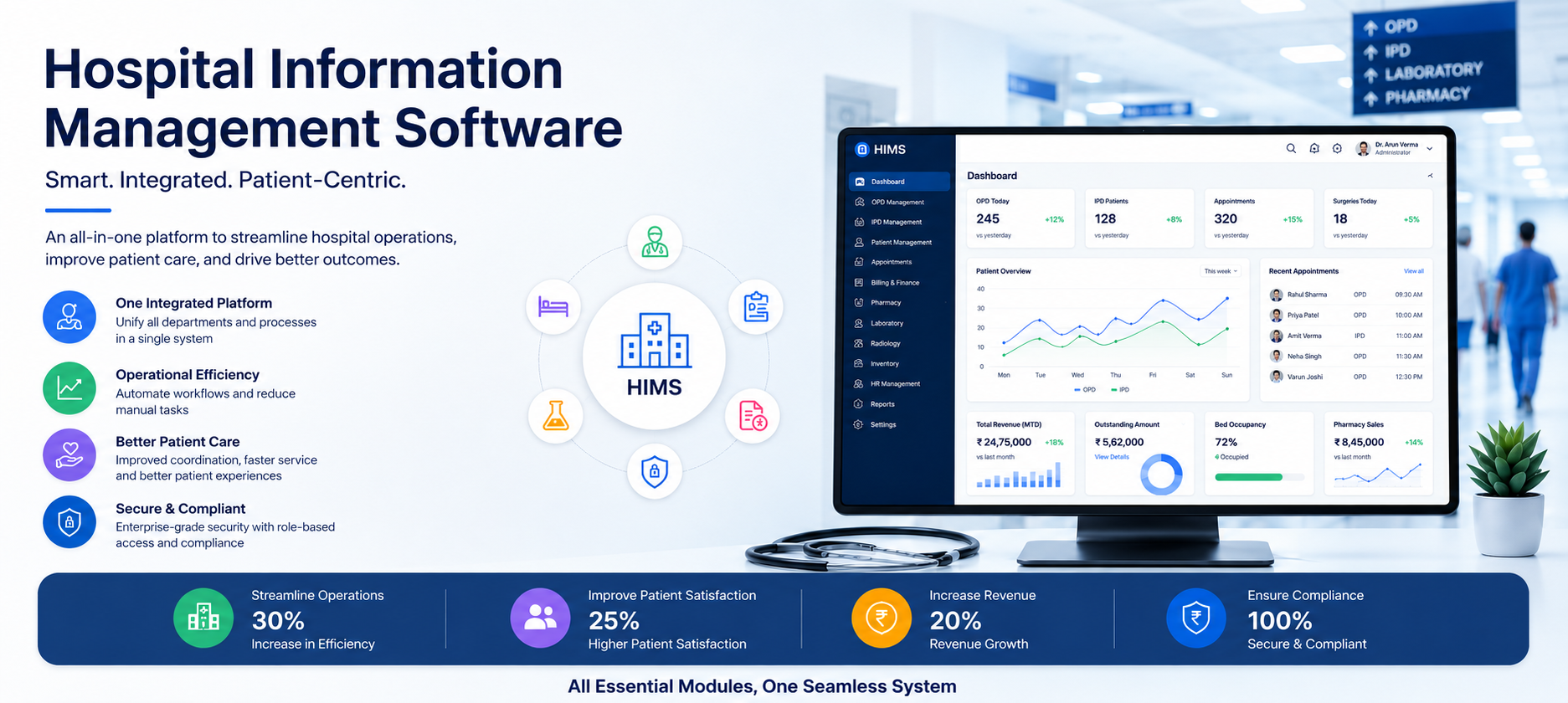
A Hospital Information Management System (HIMS) is an integrated digital platform that manages clinical, operational, financial, and administrative processes within a hospital. It connects patient registration, appointments, EMR, billing, pharmacy, laboratory, radiology, inventory, and reporting into a single system.
A modern hospital information management system software enables hospitals to reduce paperwork, improve patient care, streamline billing, and maintain compliance with healthcare regulations.
EMR (Electronic Medical Record)
An EMR is specifically the clinical record — diagnosis, prescriptions, vitals, clinical notes, and e-prescriptions. It is one module within a HIMS. Buying a standalone EMR does not give you billing, pharmacy, or operational management.
EHR (Electronic Health Record)
An EHR goes further than an EMR — it is designed to be shared across providers and health systems. In India, the ABDM/ABHA framework is effectively the national EHR infrastructure. A good HIMS will feed into and read from the EHR layer via ABDM integration.
HIS (Hospital Information System)
HIS and HIMS are used interchangeably in most Indian hospital conversations. In some international contexts, HIS refers to the administrative and financial layer while EMR refers to the clinical layer. In practice, evaluate what specific modules any vendor's system includes — the label matters less than the feature coverage.
Why Choosing the Right Hospital Management Software Matters
Patient volumes are rising, compliance requirements are growing, and digital records are now essential. A poor HIS leads to duplicate data entry, delayed discharges, and workflow inefficiencies. Hospitals that digitize OPD, IPD, pharmacy, and lab operations benefit from faster billing, fewer errors, reduced revenue leakage, and improved care coordination.
Essential Hospital Information Management System Modules to Evaluate
Before comparing vendors, map what you need on day one versus phase two. Most mid-size hospitals in India and the Gulf start with registration and billing, then expand:
- Patient Registration and EMR
Create a single patient record across registration, consultations, pharmacy, lab, and billing. Look for structured notes, e-prescriptions, digital vitals, and separate OPD/IPD records. - Appointment and Queue Management
Scheduling should sync with doctor availability, generate tokens, and manage walk-ins efficiently. Digital queue management helps reduce wait times and front-desk workload. - Billing and Insurance (TPA Management)
The system should support cash, credit, TPA, Ayushman Bharat, and package billing from one screen. Audit trails and duplicate charge detection are essential. - Pharmacy and Inventory Management
Prescriptions should flow directly from the EMR to the pharmacy. Look for real-time stock updates, expiry alerts, reorder notifications, and controlled drug tracking. - Laboratory Integration
Lab orders should be sent digitally, and results should automatically update the EMR. Check for LIMS integration and support for external lab connections via API or HL7. - Radiology and PACS Integration
Radiology orders, images, and reports should be linked to patient records. PACS integration is especially important for multi-specialty hospitals. - MIS and Dashboards
Real-time dashboards should provide visibility into bed occupancy, revenue, patient flow, inventory, and insurance claims, helping management make faster decisions.
Key Features to Look for in Hospital Management Software
Healthcare workflows are not warehouse workflows. When shortlisting hospital management software India vendors, score each product on:
-
Time to go-live with your existing departments and user roles — weeks, not years
-
Whether clinical, billing, and pharmacy share one patient record without re-entry
-
Configurability for local billing rules, doctor shares, insurance formats, and GCC payer rules where relevant
-
Integration readiness for labs, radiology, ABDM ABHA, and third-party systems
-
Training and post-go-live support — not install-and-disappear
How to Successfully Implement Hospital Information Management System Software
The most successful deployments start with a ready product foundation and configure around existing workflows. CSoft takes this product-led approach with CSoft HIMS — a hospital information management platform that covers core modules out of the box and is customized where your hospital differs from standard templates.
Rather than a multi-year IT programme, hospitals phase go-live by department: OPD and billing first, then IPD, pharmacy, and lab — while daily operations continue. Pair HIMS with telemedicine and RCM automation when you are ready; the foundation should not force a rebuild later.
Hospital Management Software Requirements for GCC Hospitals
Hospitals in the UAE, Saudi Arabia, Qatar, and other GCC markets operate under regulatory frameworks that differ meaningfully from India. If you are evaluating hospital management software for a GCC facility, verify the following before shortlisting any vendor.
Regulatory Compliance by Country
-
UAE (federal): MOH (Ministry of Health & Prevention) registration requirements; electronic health record standards under the UAE National Digital Health Strategy
-
Dubai: DHA (Dubai Health Authority) facility and system approval; NABIDH health information exchange connectivity
-
Abu Dhabi: DOH (Department of Health Abu Dhabi) compliance; Malaffi HIE (Health Information Exchange) integration
-
Saudi Arabia: CCHI (Council of Cooperative Health Insurance) claims formats; NPHIES integration for insurance and e-prescribing
-
Qatar: PHCC and Hamad Medical Corporation standards for private hospital interoperability
Benefits of Hospital Information Management System Software
A hospital information management system (HIMS) helps hospitals manage patient records, billing, pharmacy, laboratory, and administrative tasks from one platform. This improves efficiency, reduces errors, and supports better patient care.
- Improves Patient Care: Doctors and staff can access patient information quickly, helping them make better treatment decisions.
- Reduces Billing Errors: Integrated billing helps capture all charges accurately and reduces revenue loss. Saves Time: Staff spend less time on paperwork and duplicate data entry.
- Better Inventory Management: Tracks medicine and medical supplies in real time, reducing shortages and wastage.
- Supports Compliance: Helps hospitals maintain accurate records and meet healthcare regulations.
- Provides Real-Time Reports: Hospital administrators can monitor revenue, patient flow, and operational performance through dashboards.
- Enhances Patient Experience: Faster registration, shorter waiting times, and smoother discharge processes improve patient satisfaction.
A well-implemented HIMS helps hospitals streamline operations, improve efficiency, and deliver better healthcare services.
Ready to Transform Your Hospital with the Right HIMS?
Book a free HIMS consultation to discuss your hospital's workflows, challenges, and digital transformation goals. Our experts will help you understand how an integrated HIMS can streamline operations across OPD, IPD, billing, pharmacy, laboratory, and administration.