
A head of department once needed a simple answer: how many extraction cases had final-year students completed under supervision this term? The answer took three days to put together. It came from paper registers, a few department spreadsheets, and an OPD system that had no idea students existed.
This is the everyday reality in most dental colleges. A dental college hospital is not one institution — it is a teaching campus and a working hospital running at the same time, in the same rooms. Generic hospital management software is built for the second half of that job and has no idea the first half exists.
"Our students train across nine departments. The software we bought treats us like a small general clinic that happens to have a dental chair."
— Head of Department, private dental college, South India
A purpose-built dental college hospital management system connects patient care, student case records, faculty supervision, and institutional reporting in one place — so nobody is rebuilding that picture by hand every time an inspection or exam cycle comes around.
National Dental Commission (NDC): What It Means for Dental College Hospital Management Systems
If your compliance documents still say "Dental Council of India," it's time for an update. In March 2026, the Government of India dissolved the DCI and replaced it with the National Dental Commission (NDC), a new regulatory body created under the National Dental Commission Act. The old Dentists Act, 1948, was repealed the same day.
The NDC now works through three specialised boards:
- Undergraduate and Postgraduate Dental Education Board — oversees courses and curriculum
- Dental Assessment and Rating Board — handles accreditation and institutional assessment (this is the board that inherits DCI's old inspection role)
- Ethics and Dental Registration Board — governs professional conduct and dentist registration
This matters for your software strategy for one simple reason: any compliance dashboard, case-log format, or reporting template built purely around "DCI requirements" now needs to speak the language of the NDC and its Dental Assessment and Rating Board instead. Institutions that were separately told to move to electronic health records under a 2025 DCI circular should also confirm how that requirement now sits under the new commission — the underlying expectation of digital, auditable patient and student records has not gone away, and if anything, a more rating-and-assessment-driven regulator makes it more important.
The practical takeaway: choose a system built to adapt its compliance reporting as the regulatory structure evolves, not one hard-coded to a body that no longer exists.
What Generic Hospital Software Misses in a Dental College
Most hospital management systems are built for clinics, not teaching hospitals. Here's what they routinely miss:
- Student case log tracking — which procedures each student performed, under whose supervision, and whether it counts toward their clinical quota
- Faculty sign-off workflows — digital approval of student case sheets, not a stack of papers waiting for a signature
- Chairside and department scheduling — dental chairs, speciality clinics, and student rotation schedules, not just doctor appointments
- Treatment planning by dental speciality — Orthodontics, Prosthodontics, Oral Surgery, Pedodontics, and more, each with different workflows
- Academic and clinical integration — linking patient treatment records to the student's academic file, so both tell the same story
Without these, faculty end up keeping shadow records on the side — the exact paper trail digital systems were supposed to remove.
Why Dental Colleges Need a Digital Hospital Management System Instead of Paper Records
Paper and spreadsheet-based tracking doesn't just slow things down. It creates risk in three specific ways:
Lost data during accreditation season. When assessment teams ask for case completion numbers, colleges scramble to reconcile paper logs against attendance registers and clinic notes — often finding gaps that are hard to explain after the fact.
Inconsistent student records. Without a shared system, one department's case log format doesn't match another's. Comparing a student's progress across nine departments becomes a manual, error-prone exercise.
Delayed patient care coordination. A patient referred from screening to a speciality department for follow-up often has to repeat their history because records don't travel with them electronically.
Institutions that move to a connected system typically see faculty spend far less time on administrative paperwork and far more time on teaching and patient care — because the record-keeping happens inside the clinical workflow, not after it.
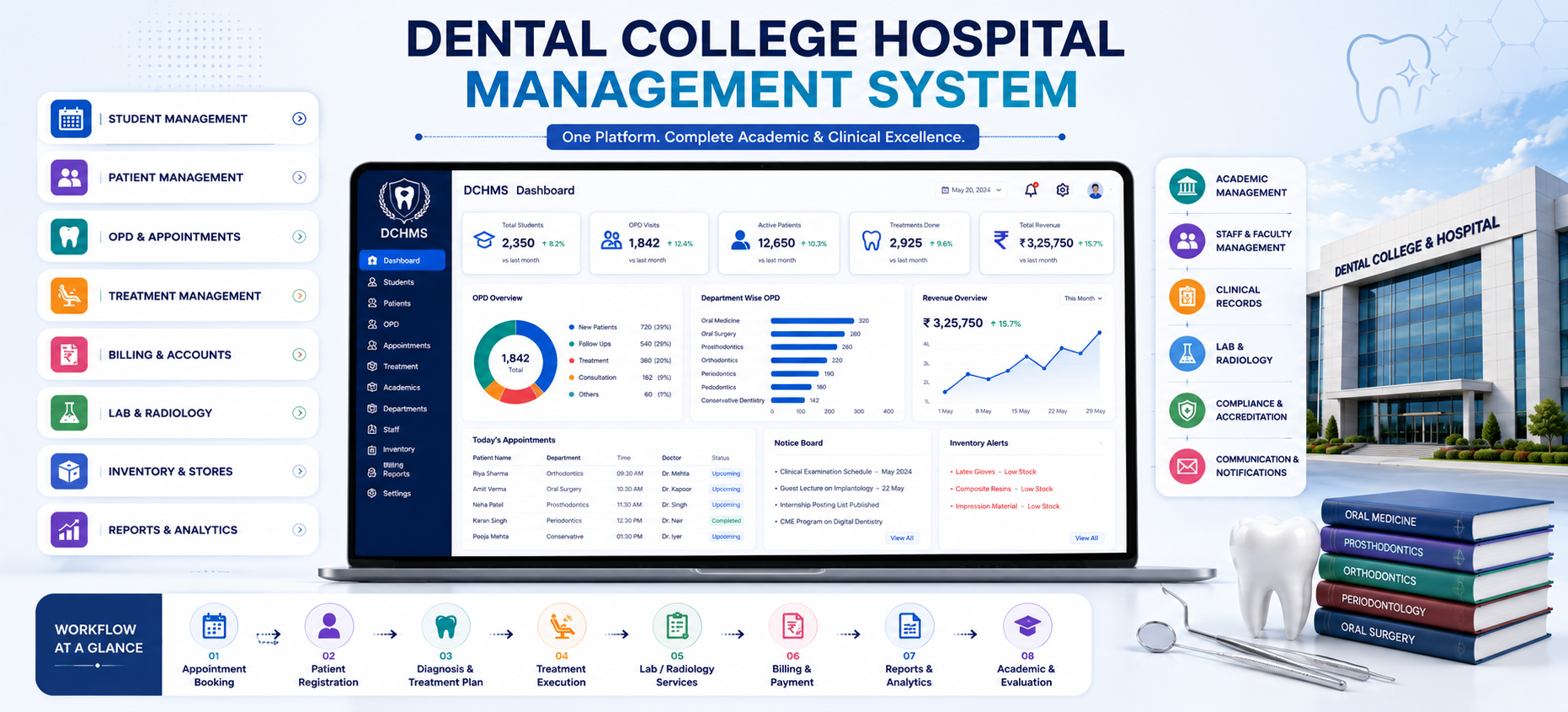
What a Dental College Hospital Management System Should Actually Include
Based on how dental colleges actually operate, a complete system needs to cover these areas:
Patient Registration & OPD/IPD. One patient record across every dental department, with OPD token management, IPD bed allocation where applicable, and a complete treatment history that any department can access.
Student Clinical Case Records. Digital case sheets and procedure quotas for every student, with faculty supervision and sign-off built directly into the workflow — not bolted on afterward.
Department Scheduling & Faculty Supervision. Appointments across Orthodontics, Periodontics, Prosthodontics, Oral and Maxillofacial Surgery, Pedodontics, Conservative Dentistry and Endodontics, Oral Medicine and Radiology, Oral Pathology, and Public Health Dentistry — with chair allocation, faculty rosters, and supervision assignments.
Treatment Planning & Tracking. Procedure codes, progress tracking, radiograph records, and clinical notes tied to each patient visit.
Compliance & Accreditation Reporting. Reports and dashboards configured around current regulatory requirements — including student-to-faculty ratios, clinical case quotas, and infrastructure checklists — that stay ready for inspection, not assembled the week before one.
Dental Inventory Management. Materials, instruments, implants, and consumables tracked across departments, with reorder alerts so a shortage in one clinic doesn't stop procedures.
Billing & Fee Management. Patient treatment billing, student fee collection, insurance claims, and concession handling, with GST-compliant invoicing.
Institutional Reporting & Multi-Campus Visibility. Role-based dashboards for deans, heads of department, and administrators, with unified reporting across campuses and affiliated outreach clinics.
How a Dental College Hospital Management System Improves Student Clinical Training
A Dental College Hospital Management System simplifies clinical training by digitizing student case records and faculty supervision. Instead of relying on paper logbooks and spreadsheets, colleges can track every clinical procedure in real time, making it easier to monitor progress and prepare for assessments.
Key benefits include:
- Digital student case logs with faculty sign-off.
- Real-time tracking of clinical quotas and student progress.
- Easy access to case records for exams and accreditation.
- Reduced paperwork and fewer manual errors.
- Better visibility for faculty and department heads.
By integrating academic and clinical workflows, the system helps students gain hands-on experience while giving faculty accurate, up-to-date information for supervision and performance evaluation.
Dental College Hospital Management System vs Hospital HMS vs Dental Practice Software
These three categories get confused often, and picking the wrong one is an expensive mistake. Here's the real difference:
General hospital management software (HIMS) is built for multi-speciality hospitals treating walk-in patients. It handles OPD, IPD, billing, and pharmacy well, but has no concept of a student, a case quota, or a faculty supervisor. Bought for a dental college, it manages the hospital half of the campus and ignores the teaching half entirely.
Standalone dental practice software is built for a single dentist or a small private clinic. It's strong on charting, treatment plans, and patient billing for one or two chairs — but it has no idea how to handle nine departments, rotating student batches, or institutional-level reporting across a whole college.
A dental college hospital management system sits between the two, built specifically for the combination: the patient-care depth of dental software, the multi-department scale of a hospital system, and an academic layer — case logs, faculty sign-off, and student quotas — that neither of the other two categories was ever designed for.
If you're evaluating vendors, ask directly which category their product was originally built for. A dental or hospital feature that was "added later" to fit your college usually behaves like an add-on — separate logins, separate reports, and separate data that someone still has to reconcile by hand.
Data Security and Patient Privacy Under the DPDP Act
A dental college hospital handles two categories of sensitive personal data: patient health records and student academic records. Both fall under India's Digital Personal Data Protection (DPDP) Act, and both need to be treated with the same seriousness — not just the patient side.
A few things worth checking in any system you evaluate:
- Role-based access control, so a first-year student can't view every patient record in the hospital, and a billing clerk can't view clinical notes
- Audit trails on every record, showing who viewed or edited a patient file or a student case sheet, and when
- Consent capture at registration, especially for teaching-related use of patient records, photographs, or radiographs in academic case discussions
- Data retention and access policies that hold up if a regulator, an accreditation team, or a patient asks how their data is stored and who can see it
These aren't features you add after go-live. They need to be part of the system's design from day one, because retrofitting access control onto years of existing records is far harder than building it in from the start.
Why CSoft DIMS Is Built for Dental College Hospital Management
CSoft DIMS is designed specifically for dental colleges and teaching hospitals — covering OPD/IPD registration, treatment documentation, student case tracking, faculty supervision, billing, inventory, and institutional reporting configured for how dental colleges actually run.
Where a general hospital needs CSoft HIMS, a dental college hospital needs DIMS — the same deployment discipline, built around academic and clinical requirements that are genuinely different. You can see how this plays out in practice in our DIMS case study for a dental college hospital.
How to Implement a Dental College Hospital Management System Successfully
A dental college can't pause patient care or teaching to switch systems. A phased rollout works better than a single go-live date:
- Start with your highest-volume department. Roll out by department, beginning with the clinic that sees the most patients and students, so early issues surface and get fixed before a full rollout.
- Build case log entry into the consultation itself. If students and faculty only log cases at the end of the week, adoption fails. Case entry needs to happen as part of the actual patient visit.
- Involve academic administration early. Reports need to match the formats your institution actually submits for internal review and external assessment — decide this before configuration, not after.
- Connect billing and pharmacy to patient records. This keeps revenue from teaching cases separate and traceable from regular patient billing.
- Train every role, not just administrators. Faculty, students, billing staff, and IT administrators all need hands-on training — a system only works if the people entering data every day are comfortable using it.
What to Check Before You Choose a Dental College HMS
Before shortlisting a vendor, get clear answers on these points:
- Does it track student clinical case logs with faculty sign-off, or does it treat every patient the same regardless of who's supervising?
- Can it schedule by chair and department, not just by doctor — dental colleges run multiple speciality clinics in parallel.
- Is compliance reporting configurable, so it can adapt as regulatory structures change, rather than hard-coded to one authority's old format?
- Does it support your actual case sheet formats, or will your institution have to redesign its academic records to fit the software?
- What does implementation and training actually look like, and does support continue after go-live until adoption is steady across every department?
Getting straight answers on these five points tells you more about a vendor's fit for dental colleges than any feature list.
Benefits of a Dental College Hospital Management System for Faculty, Students, and Administrators
A dental college hospital management system doesn't just change reporting at the top. It changes daily work for everyone on campus:
For the Dean or Principal. Institution-wide visibility into patient volume, department performance, and case completion — available anytime, not assembled only when an inspection is announced.
For Heads of Department. A real-time view of which students are on track with their case quotas and which need attention, instead of finding out at the end of the term.
For Faculty. Case sign-off that happens during the consultation, not a pile of case sheets waiting for a signature at the end of the week.
For Students. A clear, always-up-to-date record of their own case completion — useful for their own tracking, not just the institution's.
For Patients. One record that follows them across departments, so a patient referred from screening to a speciality clinic doesn't have to repeat their history from scratch.
For Administrators. Billing, inventory, and fee collection in one place, instead of reconciling three separate systems every month.
Why Every Dental College Needs a Modern Hospital Management System in 2026
Dental education in India is going through its biggest structural change in decades, with a new regulator, new assessment boards, and a stated push toward more transparent, rating-driven institutional evaluation. At the same time, digital health records and student case documentation are no longer optional extras — they are baseline expectations.
Institutions that already run on a connected, digital system are in a far better position to adapt to new reporting formats as they arrive. The ones still running on paper and spreadsheets will be rebuilding their records under pressure, right when scrutiny is highest.