
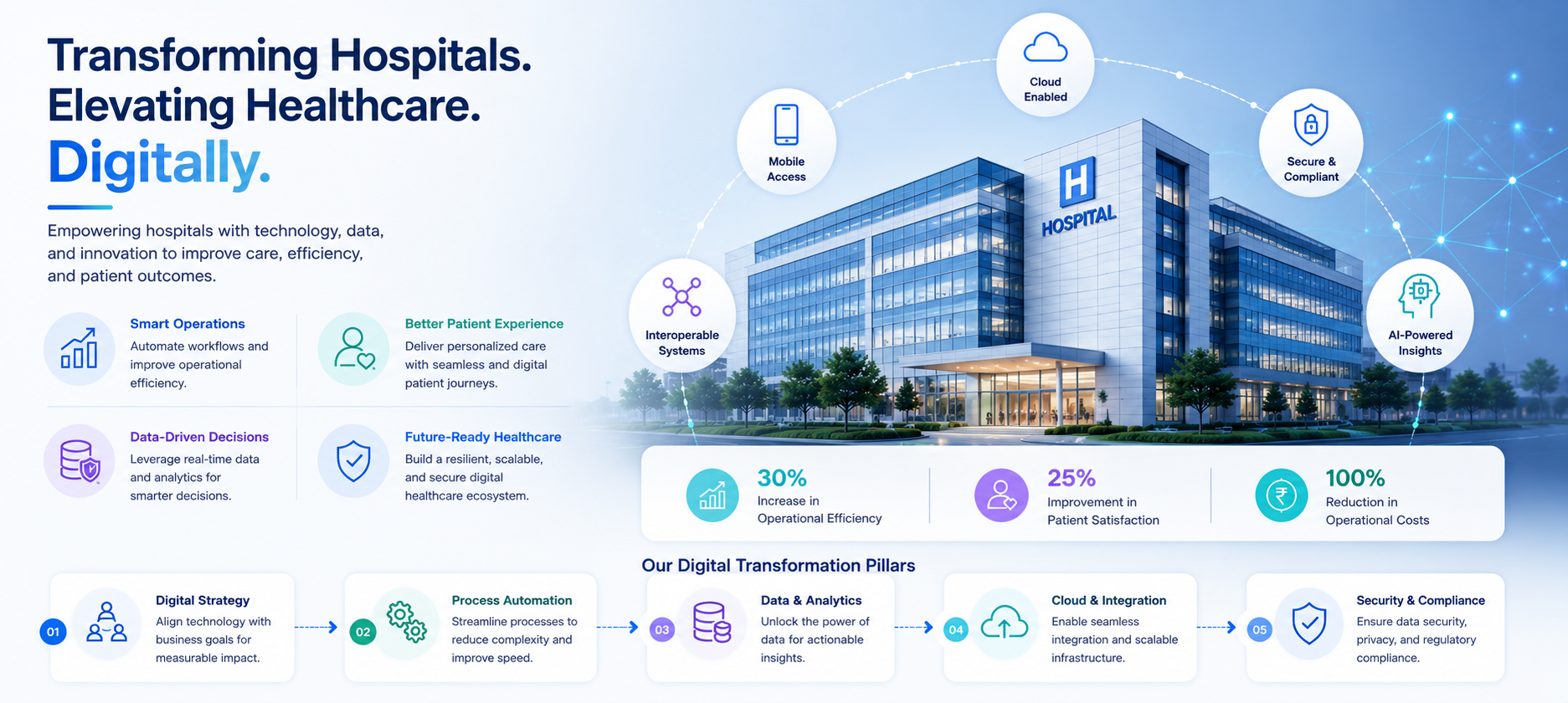
Most hospitals do not struggle because they lack ambition. They struggle because patient data lives in three different places — a register at OPD, an Excel file in finance, and a billing module that does not talk to pharmacy. Every day, staff re-enter the same information. Errors pile up. Discharge summaries go missing.
Hospital digital transformation fixes this — not by replacing everything overnight, but by connecting patient, clinical, and financial data step by step, around how your hospital already runs.
"We were not afraid of technology. We were afraid of stopping the hospital for six months to install it." — COO, Multi-Speciality Hospital, Kerala
This fear is common. And it is avoidable. Modern healthcare software solutions are designed for phased rollouts — so your hospital keeps running while the new system comes online department by department.
What Is Hospital Digital Transformation and Why Is It Important?
Hospital digital transformation is the process of replacing paper-based records, spreadsheets, and disconnected software with a single digital system that connects all departments. This allows patient, clinical, administrative, and financial information to move smoothly across the hospital.
In 2026, digital transformation is no longer a choice for hospitals. Patient expectations are rising, claim rejections are increasing, and government initiatives such as the Ayushman Bharat Digital Mission (ABDM) are encouraging healthcare providers to adopt digital systems. Hospitals that modernize their operations can improve efficiency, reduce errors, save costs, and provide better patient care.
Why Hospitals Need Digital Transformation
- Government requirements: ABDM and ABHA integration are becoming increasingly important for hospitals participating in government healthcare programs and insurance schemes.
- Changing patient expectations: Patients now expect online appointment booking, digital reports, and easy access to prescriptions and medical records.
- Financial challenges: Manual processes often lead to billing errors, claim rejections, and inventory losses. Digital systems help reduce these issues and improve revenue management.
- Staff shortages: Many hospitals face shortages of doctors and nurses. Automating routine tasks reduces administrative work and allows healthcare professionals to focus more on patient care.
Hospital digital transformation does not mean changing everything overnight. It is about implementing the right technology step by step while ensuring that daily hospital operations continue without disruption.
How Digital Healthcare Solutions Improve the Patient Journey
Digital healthcare solutions help hospitals connect departments through a single system. Instead of using separate applications, all patient information is stored in one digital record that can be accessed by doctors, nurses, pharmacists, lab staff, and administrators.
When a patient registers, their information automatically becomes available across the hospital, reducing paperwork, duplicate data entry, and errors.
How Digital Healthcare Solutions Support Different Departments
- OPD and Registration: Patients can register digitally using their ABHA ID or mobile number. Queue management systems help reduce waiting times and improve patient flow.
- Doctor Consultations: Doctors can view medical history, prescriptions, test reports, and allergies in one place. Electronic prescriptions are sent directly to the pharmacy.
- Pharmacy: Medicines are dispensed digitally, and inventory is updated automatically, helping maintain accurate stock records.
- Laboratory and Radiology: Test requests are sent electronically, and completed reports are added directly to the patient's record for quick access.
- Billing: Consultation charges, tests, procedures, and medications are recorded automatically, reducing billing mistakes and improving revenue management.
- Management Dashboard: Hospital administrators can monitor bed occupancy, patient flow, revenue, and operational performance through real-time dashboards.
When implemented properly, digital healthcare solutions create a connected hospital environment where information flows smoothly between departments. This improves efficiency, reduces administrative work, and helps deliver better patient care.
How to Choose the Best Healthcare Software Solutions for Your Hospital
The healthcare software solutions market in India is highly competitive, with many vendors offering hospital management systems, cloud platforms, AI tools, and ABDM-compliant solutions. However, choosing software based only on features can lead to poor adoption and operational challenges.
The right solution depends on your hospital's size, speciality, workflows, and business requirements. A system that works well for a large multi-speciality hospital may not be suitable for a smaller healthcare facility.
When evaluating healthcare software solutions, focus on these key factors:
- Workflow Fit: Choose software that matches your hospital's daily operations. A system that supports existing workflows is more likely to be adopted by staff.
- Built-In Compliance: Ensure the platform supports healthcare standards such as ABDM and ABHA integration without requiring complex add-ons.
- Integrated Patient Records: Billing, pharmacy, laboratory, and clinical departments should work from a single patient record to improve efficiency and reduce errors.
- Phased Implementation: Select a vendor that can implement the system gradually, allowing hospital operations to continue without disruption.
- Reliable Support: Look for vendors that provide proper training, implementation assistance, and ongoing support when needed.
- Proven Results: Ask for references from hospitals of a similar size and speciality to understand how the solution performs in real-world settings.
The best healthcare software solution is one that fits your hospital's workflows, is easy for staff to use, and helps improve patient care while streamlining operations.
How to Evaluate a Healthcare Software Development Company Before Buying
Choosing a healthcare software development company is a long-term decision. The software is important, but implementation, support, and future updates are equally important.
A company that builds healthcare software specifically for Indian and GCC hospitals usually understands hospital workflows better than a company using a generic ERP system.
Here are a few things to check:
- ABDM and ABHA Integration: The platform should support smooth ABHA ID creation and patient record linking without extra complexity.
- Insurance and TPA Claims: The software should already support common Indian insurance and TPA claim formats to reduce manual work.
- Multi-Language Support: Patient-facing features like registration, appointments, and discharge instructions should be available in regional languages.
- Regulatory Updates: The company should regularly update the software to stay compliant with ABDM requirements and data privacy regulations.
Before signing a contract, ask how the company handles compliance updates, critical bug fixes, and workflow changes after implementation. Their answers will tell you more about their reliability than any product demo.
Digital Healthcare Software India: The Growth of Hospital Digitisation
Hospital digitisation in India is growing, but adoption is still uneven. Large hospital groups already use advanced hospital management systems, while many small and mid-sized hospitals still depend on paper records, spreadsheets, and basic billing software.
Today, digital healthcare software adoption is increasing rapidly among independent hospitals. Government initiatives, ABDM requirements, and affordable cloud-based solutions are making digital transformation easier and more affordable.
Key factors driving adoption include:
- Cloud-Based Platforms: Hospitals can use software without investing in expensive servers or IT infrastructure.
- Affordable SaaS Pricing: Subscription-based models reduce upfront costs and make budgeting easier.
- ABHA Integration: Digital patient records help reduce manual data entry and improve registration efficiency.
- Government Support: Some state governments provide incentives and implementation support for ABDM-compliant healthcare software.
For hospitals planning to modernize in 2026, the focus is no longer on whether to digitize but on choosing the right platform and implementing it with minimal disruption to daily operations.
Healthcare IT Solutions: Meeting ABDM and DPDP Compliance Requirements
Modern healthcare IT solutions India hospitals use must meet growing regulatory and data security requirements. With ABDM, the DPDP Act, and various government insurance schemes, compliance is now an essential part of hospital operations.
A compliant healthcare platform should manage patient data securely, support regulatory standards, and simplify reporting requirements.
Key Compliance Features Hospitals Need
- ABDM and ABHA Integration: Patient records should be linked to ABHA IDs, support digital health records, and include consent management for secure data sharing.
- DPDP Act Compliance: The system should record patient consent, follow data retention policies, and maintain audit logs showing who accessed patient information.
- Standardized Clinical Data: Support for ICD-10 and SNOMED CT coding helps with accurate record keeping, data exchange, and insurance claims.
- Role-Based Access Control: Staff should only access information relevant to their roles. For example, billing teams should not view detailed clinical notes.
- Government Insurance Scheme Support: The platform should generate claim data for schemes such as PM-JAY and Aarogyasri without requiring manual formatting.
Compliance is not a one-time task. The best healthcare IT solutions India platforms keep up with changing regulations, provide regular updates, and help hospitals remain audit-ready at all times.
Hospital Management Software: Essential Features for Modern Hospitals
Hospital management software India hospitals use should support all major hospital operations through a single connected system. From patient registration to billing and reporting, every department should work together seamlessly.
Patient Registration and OPD Management
A good registration system should quickly create patient records, support ABHA ID integration, manage appointments, and automatically handle OPD queues. This helps reduce waiting times and data entry errors.
Electronic Medical Records (EMR)
The EMR acts as the central patient record. Doctors can access medical history, prescriptions, diagnoses, and treatment details in one place. Standardized records also support insurance claims and ABDM compliance.
Pharmacy and Inventory Management
Prescriptions should flow directly from the doctor's system to the pharmacy. Inventory should update automatically when medicines are dispensed, while stock alerts and expiry tracking help prevent shortages and wastage.
Billing and Revenue Cycle Management
All charges, including consultations, tests, procedures, and medications, should be captured automatically. Integrated insurance claim processing helps reduce manual work and billing errors.
Reports and Management Dashboard
Hospital administrators need real-time visibility into operations. Dashboards should provide information on bed occupancy, revenue, patient flow, pharmacy inventory, and pending insurance claims from a single screen.
A well-designed hospital management software India platform connects all departments, improves efficiency, reduces paperwork, and helps hospitals deliver better patient care.
AI in Healthcare: Real Applications Delivering Results
AI in healthcare India is growing quickly, but not every AI feature provides real value. Today, a few practical applications are helping hospitals save time, improve efficiency, and reduce costs.
AI medical scribe
Doctors spend a lot of time writing clinical notes. AI Medical Scribe technology can automatically generate consultation notes from conversations, allowing doctors to review and approve them instead of typing everything manually. This helps reduce administrative workload and improves productivity.
Revenue Cycle Management (RCM) Automation
AI helps automate insurance claims, pre-authorizations, and rejection management. It can identify missing information, predict claim issues, and track pending approvals, helping hospitals improve claim success rates and recover revenue faster.
Predictive Bed and Resource Management
AI can analyze historical hospital data to predict patient admissions and bed demand. This helps administrators plan resources more effectively and avoid capacity issues.
Diagnostic Support
AI-powered tools can highlight possible abnormalities in X-rays, CT scans, and other medical images. This helps radiologists review cases more efficiently while maintaining clinical oversight.
For most hospitals, the best approach is to start with AI solutions that solve everyday operational challenges. In many cases, AI medical scribe and RCM automation deliver the fastest and most measurable return on investment.
How Healthcare Automation Software Reducing Manual Work in Hospitals
Many hospital tasks are still handled manually, including appointment reminders, billing updates, insurance follow-ups, and inventory tracking. These activities take valuable time away from patient care.
Healthcare automation software helps hospitals streamline these routine processes, improving efficiency and reducing administrative workload.
Key Automation Features for Hospitals
- Automatic Billing Capture: Charges for consultations, tests, procedures, and medications are recorded automatically, helping prevent missed revenue.
- Appointment Reminders: SMS and WhatsApp reminders reduce missed appointments and improve OPD efficiency.
- Lab Result Notifications: Doctors receive alerts when test results are available, while critical results can be flagged immediately for faster action.
- Discharge Workflow Automation: Billing, pharmacy clearance, and discharge documentation can be triggered automatically when a patient is approved for discharge.
- Inventory Reorder Alerts: The system monitors stock levels and generates purchase requests when supplies fall below minimum thresholds.
- Insurance Follow-Up Automation: Pending pre-authorizations and claims can be tracked automatically, reducing manual follow-up work for billing teams.
Healthcare automation software helps hospitals reduce paperwork, improve operational efficiency, and allow staff to focus more on patient care rather than administrative tasks.
Enterprise Healthcare Software: Designed for Large Hospitals
Large hospitals and healthcare groups have more complex needs than smaller healthcare facilities. Enterprise healthcare software is built to manage multiple departments, locations, insurance providers, and large volumes of patient data through a single platform.
Key Features of Enterprise Healthcare Software
- Multi-Speciality Support: Different departments such as cardiology, oncology, orthopaedics, and paediatrics can use customized workflows while staying connected within the same system.
- Multi-Facility Management: Hospital groups can manage patient records, inventory, finances, and staff access across multiple locations from a centralized platform.
- Advanced Payer Management: The software supports cash payments, TPAs, corporate agreements, government schemes, and international insurance providers within one billing system.
- Role-Based Access Control: Staff members only see information relevant to their responsibilities, improving security and data privacy.
- API Integrations: The platform can connect with third-party systems such as HR software, laboratory equipment, and insurance portals for seamless operations.
- Advanced Analytics and Reporting: Hospital leadership can access insights on revenue, department performance, claim status, occupancy rates, and long-term operational trends.
Enterprise healthcare software helps large hospitals improve coordination, manage complex operations efficiently, and support future growth through a scalable and integrated digital infrastructure.
Digital Transformation in Healthcare: Stages of Going Paperless
Most hospitals in India and the GCC follow a phased approach when moving from paper-based processes to a digital healthcare system.
Phase 1: Registration and OPD EMR
Patient registration, appointment scheduling, digital medical records, and e-prescriptions are introduced. This creates the foundation for a paperless patient journey.
Phase 2: Billing and Pharmacy
Billing is linked directly to clinical orders, while prescriptions from the EMR are sent automatically to the pharmacy for dispensing. This improves accuracy and reduces manual work.
Phase 3: IPD and Nursing Management
Hospitals digitize inpatient operations, including bed management, nursing notes, medication administration, and discharge summaries.
Phase 4: Laboratory and Radiology
Lab tests and imaging requests move to a digital workflow. Results are automatically added to the patient's EMR, allowing faster access for doctors.
Phase 5: MIS and Analytics
Management dashboards, departmental KPIs, financial reports, and compliance reporting are implemented, providing real-time insights for better decision-making.
By following these stages, hospitals can transition to a fully paperless environment while minimizing disruption to daily operations.
Get Started with CSoft Solutions
CSoft Healthcare Solutions helps hospitals across India and the GCC streamline operations with HIMS, AI medical scribe, RCM automation, telemedicine integration, and ABDM/ABHA-compliant solutions.
Whether you are starting your digital transformation journey or upgrading an existing system, our team provides customized implementation, training, and ongoing support to ensure a smooth and successful rollout.