
A NABL assessor at a diagnostic chain in Chennai asked for the complete audit trail on a thyroid panel — who accessioned the sample, which analyser ran it, which technician verified it, and when the pathologist authorised release. The lab manager opened three Excel files and a paper register to find the answer. The assessor noted a major non-conformance on the spot.
Six months later, the same chain installed a laboratory information management system. Their next surveillance audit took half the time, with zero non-conformances on sample traceability.
At scale, no laboratory can guarantee turnaround time, accuracy, and accreditation evidence with spreadsheets. A laboratory information management system is the operational backbone of a modern lab — not an IT luxury.
This guide explains what a laboratory information management system is, how it works, its real advantages, what it costs in India, and how it applies to diagnostic labs, pharma, and pharmacy settings.
What Is a Laboratory Information Management System?
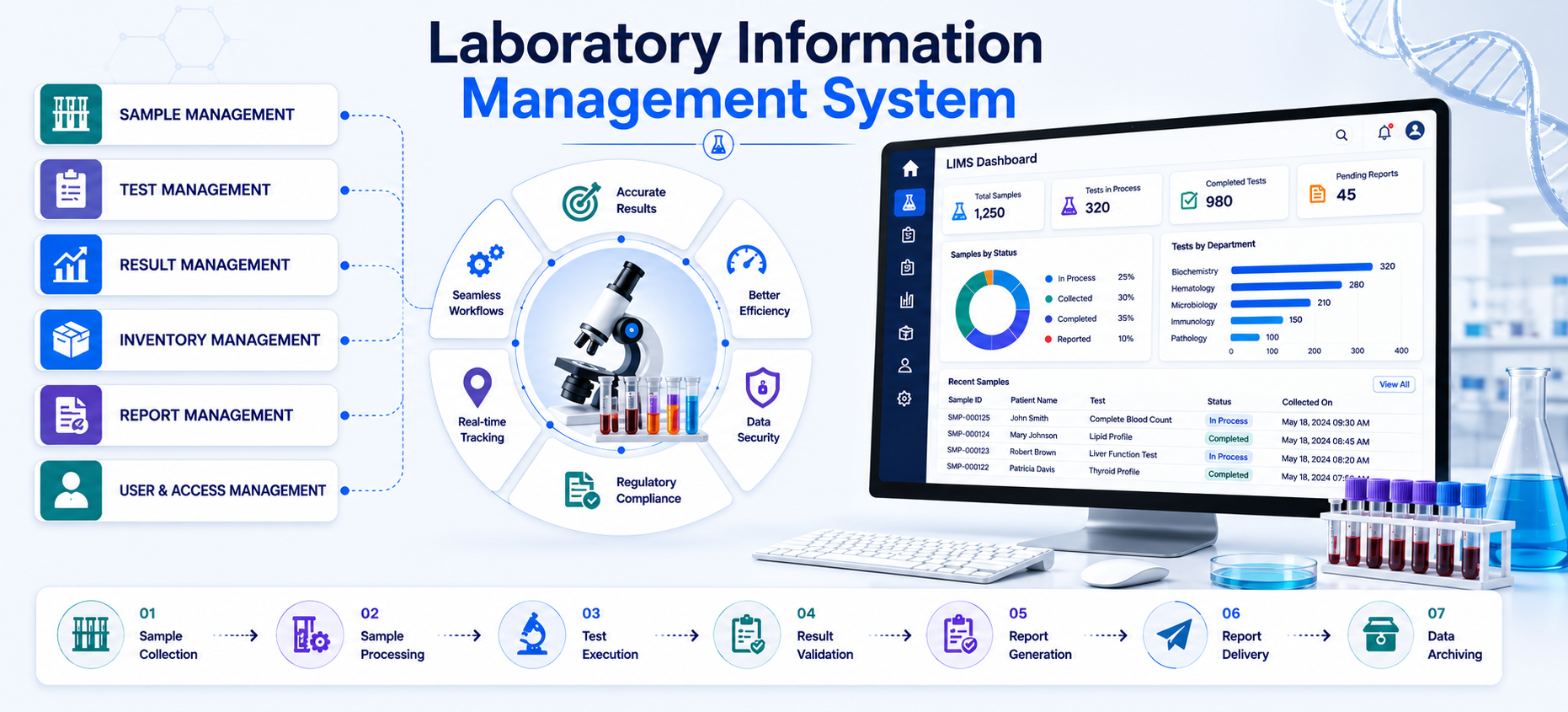
A laboratory information management system (LIMS) is software that manages a sample's entire journey through a lab — from registration and barcode labelling, through testing and quality checks, to a verified report reaching the patient or doctor. It replaces registers, loose Excel sheets, and manual report typing with one connected digital workflow.
In simple terms: a laboratory information management system is the system that tells you where a sample is right now, and who has touched it, at any point in time — instantly, with a timestamp.
Laboratory Information Management System Definition
Defined plainly, a laboratory information management system (LIMS) is a platform that automates and tracks sample accessioning, testing workflows, quality control, data storage, and report generation across a laboratory, while maintaining an auditable record of every step.
How Does a Laboratory Information Management System Work?
A laboratory information management system works by connecting every stage of the sample lifecycle into one digital record:
- Registration — patient or batch details are entered once, and a unique barcode is generated for the sample
- Accessioning — the sample is logged into the system and routed to the correct department automatically
- Testing — results are captured either manually or pulled directly from connected analysers, cutting out transcription
- Quality control — QC rules run automatically in the background, flagging any result outside expected range
- Verification — a qualified reviewer checks and digitally signs off on results before release
- Reporting — the final report is generated and delivered as PDF, print, WhatsApp, SMS link, or patient portal
Every one of these steps is timestamped and logged, which is what turns a lab's daily workflow into ready-made accreditation evidence.
Advantages of a Laboratory Information Management System
The advantages of a laboratory information management system go beyond simply going paperless:
- Fewer transcription errors — direct instrument integration removes manual result entry
- Faster turnaround time — live department queues surface bottlenecks before they cause delays
- Complete traceability — every sample's chain of custody is documented automatically
- Audit-ready compliance — NABL, ISO 17025, and GLP documentation is generated as a byproduct of daily work, not a separate task
- Better patient safety — delta checks and critical value alerts catch dangerous results immediately
- Inventory control — reagent lots, expiry dates, and reorder points are tracked without manual stock counts
- Business visibility — lab leadership can see revenue per test, TAT performance, and analyser utilisation in one dashboard
Laboratory Information Management System Software: Must-Have Capabilities in 2026
Not all laboratory information management system software is built the same. Here's what to expect from a modern platform:
- Barcode accessioning — a unique barcode from collection to report dispatch
- Workflow routing — department-wise queues with live TAT tracking
- Instrument integration — direct result capture from analysers
- Quality control automation — Westgard rules, Levey-Jennings charts, and calibration records
- Delta checking — automatic flags when a result differs sharply from a patient's previous value
- Critical value alerts — instant notification to the doctor, with documented acknowledgement
- Digitally signed, multi-channel reports — PDF, print, WhatsApp, SMS link, or patient portal
- Immutable audit trails — a tamper-proof history of every edit, approval, and re-run
- Reagent and inventory tracking — lot numbers, expiry monitoring, reorder alerts
Who Uses a Laboratory Information Management System?
A laboratory information management system is not limited to hospital pathology departments. It is used across a wide range of testing environments:
- Diagnostic and pathology labs — clinical chemistry, haematology, microbiology, and histopathology
- Pharmaceutical manufacturers — batch release testing, stability studies, and raw material QC
- Contract research organisations (CROs) — managing sample data across multiple sponsor studies
- Hospital-owned reference labs — processing samples referred from other hospitals and clinics
- Food, environmental, and industrial testing labs — batch and compliance testing outside healthcare
Each of these settings uses the same core LIMS engine — sample tracking, QC, and audit trails — but configures different workflows, report formats, and compliance rules on top of it.
Cloud-Based vs On-Premise Laboratory Information Management System
Labs generally choose between two deployment models, and the right one depends on infrastructure, budget, and data policy:
- Cloud-based LIMS — hosted by the vendor, accessible from any location, with lower upfront cost and faster rollout. Well suited to labs with multiple branches or home-collection operations that need centralised visibility.
- On-premise LIMS — hosted on the lab's own servers, offering more control over data residency and network isolation. Often preferred by larger hospital groups and pharma manufacturers with strict internal IT policies.
Many labs in India and the GCC now choose a hybrid approach — cloud-hosted for smaller branch labs, with on-premise or private-cloud deployment for the main reference lab handling high sample volumes and stricter data governance requirements.
Laboratory Information Management System in India
India's diagnostic industry is worth over $12 billion and growing at roughly 15% a year, with more than a lakh labs in operation — from single-pathologist clinics in tier-3 towns to national chains. A laboratory information management system in India also needs to support NABL accreditation under ISO/IEC 17025, and increasingly, integration with ABDM so ABHA-linked patient records stay current automatically.
NABL accreditation is not legally mandatory, but it has effectively become required for insurance panel empanelment, hospital outsourcing contracts, and corporate wellness tie-ups. NABL assessors expect documented audit trails, instrument calibration records, statistical QC data, CAPA logs, and role-based access control — all of which a properly configured LIMS generates automatically.
Laboratory Information Management System Market
The laboratory information management system market is expanding fast, driven by rising sample volumes, stricter accreditation requirements, and growing pharma and CRO activity. In India specifically, three forces are converging: hospital diagnostic chains scaling up, pharma manufacturers supplying roughly 20% of global generic medicines by volume, and international clients auditing suppliers against global data-integrity standards. Labs without a laboratory information management system are increasingly seen as not just operationally behind, but commercially constrained — unable to win contracts that require documented compliance.
Laboratory Information Management System in Pharmacy and Pharma
In pharmaceutical manufacturing and QC labs, a laboratory information management system supports batch release timelines, stability studies, method validation, and GLP-aligned documentation — often coordinated across multiple manufacturing sites. This is a different configuration from a diagnostic lab's LIMS, which optimises for patient turnaround time and NABL documentation instead.
In hospital pharmacy settings, LIMS data also links to inventory and dispensing records, so lab-ordered tests and pharmacy stock movements stay connected within the same digital ecosystem rather than living in separate systems.
Built for GCC Compliance Too, Not Just India
Labs operating in the UAE, Saudi Arabia, and the wider GCC face a parallel set of requirements — DHA and MOHAP licensing in the UAE, DOH standards in Abu Dhabi, and data exchange through platforms like NABIDH and Malaffi. A laboratory information management system built only for the Indian market often cannot generate the report formats or data structures these systems expect. For labs and hospital groups running operations across both regions, a LIMS designed for India and the GCC from the start avoids running two disconnected systems.
Laboratory Information Management System Cost in India
Pricing varies widely because "LIMS" covers everything from a lightweight sample-tracking tool to a full enterprise platform with instrument integration and multi-site rollout. Cost generally depends on:
- Number of users and locations — single-lab pricing differs sharply from multi-branch chain pricing
- Instrument integration scope — connecting analysers directly is typically scoped and priced separately
- Customisation — report formats, regional language headers, and non-standard workflows add implementation cost
- Support and training — go-live support and staff training should be included, not billed as extras later
The realistic way to evaluate cost is against what manual processes are already quietly costing you: repeat sample collections, delayed reports, staff hours spent reconstructing audit evidence, and the risk of a non-conformance during accreditation renewal. Ask any vendor for a quote scoped to your actual test menu and sample volume — generic pricing tables rarely reflect what a real deployment costs.
Implementation Roadmap That Minimises Disruption
- Map current sample flow, wall to wall. Identify exactly where transcription errors and verification delays happen.
- Phase go-live by department. Start with the highest-volume panel first, then expand.
- Validate QC and audit modules early if a surveillance audit is due within six months.
- Train phlebotomy staff on barcode discipline from day one. A mislabelled accession ID breaks every step that follows it.
Choosing a Laboratory Information Management System Partner
A laboratory information management system is not a one-time purchase — it grows with your test menu, accreditation scope, and client base. Prioritise vendors who:
- Understand NABL documentation requirements in detail
- Can support GCC compliance (DHA, MOHAP, NABIDH, Malaffi) if you operate there
- Offer instrument integration as a real, scoped capability
- Can integrate with your existing hospital HIMS or EMR without a separate multi-vendor interface project
- Provide training and go-live support as standard
CSoft LIMS is deployed alongside CSoft HIMS as one connected ecosystem, and configures separate workflows for diagnostic labs and pharma QC labs rather than forcing a one-size-fits-all template onto both. It also connects into RCM automation for billing and voice agents for automated result notifications.