
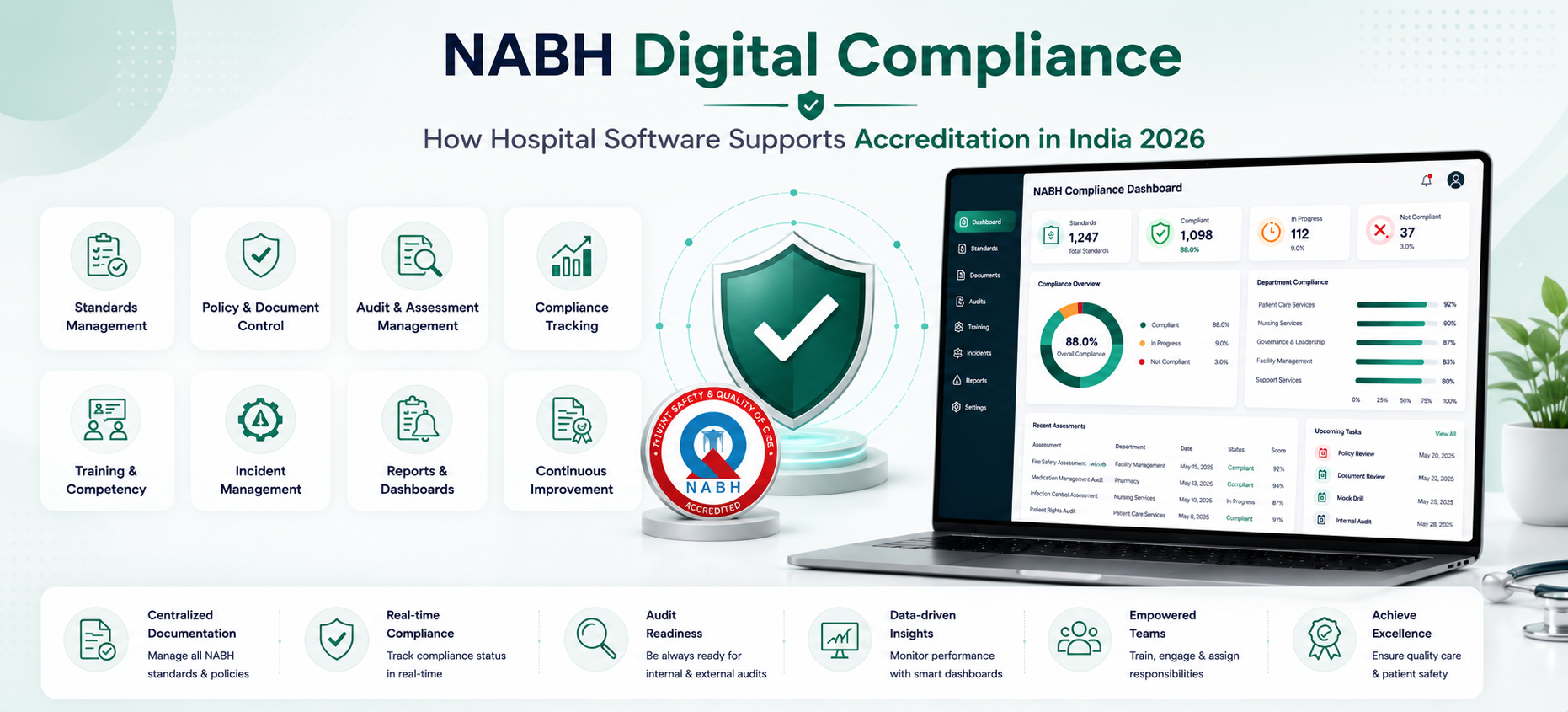
NABH's 6th edition standards, in effect since January 2025, put digital health at the centre of hospital accreditation for the first time. Hospitals are now expected to show that patient records, incident reporting, and quality indicators live in connected systems — not in registers pulled out once a year. This guide explains what changed, walks through the 10 NABH chapters, and shows where hospital software genuinely helps — and where it doesn't.
Why NABH Accreditation Matters for Hospitals
Two weeks before a NABH reassessment, a nursing home in Jaipur pulled its nursing staff off night shifts to reconstruct three months of infection surveillance registers from memory. The hospital passed, but with a conditional remark on documentation timeliness. The administrator's takeaway was simple: never depend on a pre-audit scramble again. Digital incident logs, automated quality dashboards, and EMR completeness scores became the hospital's standing operating routine, not a once-a-year fire drill.
NABH accreditation is not a folder you compile once a year. Assessors want proof that standards are followed in everyday practice — and digital systems generate that proof automatically, as staff go about their normal work.
What Does NABH Accreditation Check?
NABH (National Accreditation Board for Hospitals & Healthcare Providers) is India's healthcare quality accreditation body, set up under the Quality Council of India and recognised internationally by ISQua. NABH accreditation confirms that a hospital's patient care, safety, and management practices meet a defined national standard — something patients, insurers, and referring doctors increasingly look for before they trust a hospital.
NABH's full hospital accreditation standard is organised into 10 chapters, split between patient-centred and organisation-centred requirements:
- AAC — Access, Assessment and Continuity of Care: registration, triage, care planning, referrals, and discharge.
- COP — Care of Patients: clinical protocols across OPD, IPD, ICU, OT, and specialty care.
- MOM — Management of Medication: prescribing safety, drug interaction checks, and formulary control.
- PRE — Patient Rights and Education: informed consent, patient rights, and grievance handling.
- HIC — Hospital Infection Control: hand hygiene, sterilisation, and antimicrobial stewardship.
- PSQ / CQI — Patient Safety and Quality Improvement: quality indicators, clinical audits, and incident review.
- ROM — Responsibilities of Management: leadership accountability and strategic planning.
- FMS — Facility Management and Safety: fire safety, equipment maintenance, and OT/utility management.
- HRM — Human Resource Management: staff credentialing, training, and performance records.
- IMS — Information Management System: medical records, data security, and clinical documentation — the chapter most directly tied to your hospital software.
Each chapter carries dozens of objective elements that assessors check individually, which is why hospitals preparing on paper alone often lose track of what's actually complete.
What's New in NABH 6th Edition Standards (2025 Update)
NABH's 6th edition standards took effect for new accreditation applications from January 1, 2025, with hospitals already accredited under the 5th edition transitioning at their next renewal cycle. The headline change is a much stronger emphasis on digital health: the standards now actively recommend that hospitals maintain electronic medical records and align with India's Ayushman Bharat Digital Mission (ABDM) framework, rather than treating digitisation as optional.
In practice, this shows up across several chapters at once:
- Stronger expectations around EMR completeness and structured clinical documentation under IMS and COP.
- Closer integration between medication management (MOM) and pharmacy systems, including drug interaction alerts.
- A more defined incident reporting and CAPA (corrective and preventive action) workflow under PSQ/CQI.
- Greater weight on data security, backup, and disaster recovery practices under IMS.
None of this makes digitisation legally mandatory for accreditation on its own. But hospitals running on paper or fragmented spreadsheets now carry a heavier documentation burden to prove the same level of compliance that a connected HIMS demonstrates automatically.
NABH Hospital Accreditation vs NABH Digital Health Standards: What's the Difference?
This is a common point of confusion, so it's worth being precise. NABH runs two separate things:
- NABH Hospital Accreditation (6th edition): the core, widely known accreditation covering the 10 chapters above. This is what most hospitals mean by "getting NABH accredited."
- NABH Digital Health Standards for Hospitals: a separate, standalone accreditation programme (currently in its 2nd edition) that specifically evaluates digital maturity — HIS/EMR quality, digital infrastructure, cybersecurity, patient data privacy, and interoperability. It's assessed across areas like infrastructure, data security, and information flow, and hospitals can earn platinum or gold-level certification. As of the last public update, around 100 hospitals in India held this certification.
The two are complementary, not identical. A hospital can be NABH-accredited without holding Digital Health Standards certification, and vice versa. But hospitals pursuing both find the groundwork overlaps heavily — the same clean EMR, audit trails, and data security practices that support the 6th edition's IMS chapter also form the backbone of a Digital Health Standards application. If you're mapping a 2026 accreditation roadmap, it's worth deciding upfront which of the two — or both — you're targeting.
How Hospital Management Software Helps with NABH Accreditation
Buying a HIMS does not, by itself, get a hospital accredited. What matters is whether the system is configured to document things the way NABH assessors expect to see them: timed closure of incidents, consent captured before procedures, antibiotic stewardship flags, and a complete audit trail of who did what and when.
CSoft HIMS is implemented department by department, with reports, billing rules, and user roles configured to match how your hospital actually documents care — rather than forcing your quality team to bolt on a separate compliance module after go-live. When lab orders and results from CSoft LIMS, pharmacy dispensing, and nursing notes sit inside one connected record, assessors see closed-loop patient care instead of a stack of disconnected PDFs.
This is also where integration matters. Most hospitals don't run a single system — they have separate lab, PACS, or accounting software already in place. A HIMS built on an integration-ready architecture, using APIs and HL7 standards, means your existing systems can feed into one audit trail instead of creating three separate ones for assessors to reconcile.
What to Look for in NABH-Ready Hospital Software
You'll come across plenty of vendor marketing that calls itself "NABH-accredited software." Worth knowing upfront: NABH accredits hospitals, not software products — a vendor can build features aligned to NABH standards, but the accreditation certificate belongs to the healthcare facility that gets assessed, not the software it runs on. (NABH has separately begun piloting a certification track for EMR and HIS products themselves, distinct from hospital accreditation — worth checking directly with NABH if a vendor claims this.)
What actually matters is whether the system's features hold up during an assessment. A few things worth checking before you shortlist any HIMS for NABH readiness:
- One structured patient record per patient. Demographics, medical history, insurance details, and every visit should sit in a single record — not scattered across department-level systems that don't talk to each other.
- Timestamped audit trails on every entry. Assessors want to see who documented what and when, without gaps. This should be automatic, not something staff fill in separately.
- Clinical safety checks at the point of prescribing. Allergy flags and drug interaction warnings that fire in real time, tied to MOM chapter expectations.
- Quality indicator dashboards pulled from live data. Not a spreadsheet someone updates monthly — indicators calculated from what's actually happening in OPD, IPD, and OT.
- Digital consent capture before procedures. With a record of when consent was given and by whom, supporting the PRE chapter's patient rights requirements.
- Departments that connect, not just coexist. Registration, OPD/IPD, billing, pharmacy, ward management, and lab results should feed one patient record, so an assessor sees a closed loop instead of five separate systems.
- Reports your quality team can export on demand. If pulling evidence for an assessor takes more than a few clicks, the system isn't audit-ready yet.
CSoft HIMS covers each of these through its core workflows — one patient record across registration, OPD/IPD, billing, ward management, pharmacy, and lab coordination, with role-based reporting configured per department. It won't hand a hospital an accreditation certificate on its own, but it removes the manual reconstruction work that usually eats up the weeks before an assessment.
From Paper Registers to Audit-Ready Systems
Hospitals that maintain digital records year-round tend to sail through NABH surveillance visits. Hospitals that compile paper binders in the weeks before an assessor arrives burn out their staff and still miss gaps — because memory-based reconstruction is never as complete as a system that logged events as they happened.
The difference NABH assessors actually notice is timestamps, user IDs, and revision history. A digital system generates these automatically, every time a nurse charts a vital sign or a doctor signs a discharge summary. A paper register only produces this evidence if someone remembers to write it down accurately — and under pressure, that's exactly what breaks down.
Incident Reporting and a Real Safety Culture
Anonymous-friendly digital reporting interfaces tend to increase near-miss reporting — the small events that predict serious harm before it happens. A good workflow routes each incident to the quality team automatically, with SLA reminders so nothing sits unresolved. Trend analysis across incidents — recurring medication errors on a particular ward, or a pattern of falls at certain shift times — feeds directly into the CAPA process NABH's PSQ/CQI chapter expects.
This is one area where paper genuinely can't compete. A box of incident report slips on a wall doesn't trend on its own. A database does — automatically, and without extra staff effort.
Quality Indicators Leadership Can Actually Use
Manually compiled KPI spreadsheets are usually a month stale by the time anyone reads them. Indicators pulled directly from hospital operations — hand hygiene compliance, readmission rates, OT utilisation, average length of stay — can refresh in time for a monthly quality meeting instead of an annual scramble. That means hospital leadership can intervene on a slipping metric early, and NABH assessors see continuous monitoring in place instead of a report assembled just for their visit.
Connecting NABH Compliance to Your Broader Digital Roadmap
Accreditation-ready documentation doesn't exist in isolation — it feeds directly into other digital priorities. Clean, structured patient records make it easier to connect with ABDM and India's health data ecosystem through an interoperability hub, and they support cleaner insurance claims through RCM automation, since documentation gaps are usually what triggers claim rejections in the first place. The same patient ID and audit standards extend naturally into telemedicine consultations and a patient wallet for digital payments and records access — so compliance work you do for NABH doesn't stay siloed to one accreditation cycle.
A Practical Roadmap for Your 2026 Accreditation Cycle
If your hospital is preparing for a fresh NABH application, a renewal under the 6th edition, or a Digital Health Standards application, the same basic sequence applies:
- Gap-assess chapter by chapter. Go through all 10 chapters and mark where current documentation — paper or digital — falls short of what an assessor would expect to see.
- Map each gap to a system change. Some gaps need a workflow fix (e.g., who signs consent forms and when); others need a HIMS module configured correctly (e.g., structured discharge summaries).
- Train by role, not by department. Nurses need to know incident entry. Doctors need EMR completeness habits. Quality staff need to know how to pull dashboard exports on demand.
- Treat the assessor visit as validation, not a deadline. If your hospital already documents this way every day, the assessment simply confirms it — it isn't a separate project to sprint toward.
NABH accreditation and renewal timelines typically run several months from gap analysis to final assessment, so starting the chapter-by-chapter review early — rather than in the final quarter before your assessment date — makes the difference between a calm process and a scramble.
Prepare Your Hospital for NABH Accreditation with CSoft HIMS
CSoft HIMS supports NABH-aligned workflows through structured EMR documentation, incident reporting, quality indicator dashboards, and department-level reporting — configured to match how your hospital actually runs, not a generic compliance template.