
Priya runs a well-stocked pharmacy next to a hospital in Hyderabad. She has been open for twelve years. Good reputation. Loyal patients.
Last year, she started noticing something. Patients were collecting their discharge prescriptions — and placing the order on their phone before they even reached her counter. By the time they walked past, the order was already placed on a national app.
She wasn't losing customers because of price. She was losing them because she wasn't online.
That is the reality for thousands of pharmacies, hospital pharmacy departments, and medical retailers in India right now. The patients are already there. The demand is already there. The platform is what's missing.
An online medical shop is not just a website where you list medicines. It is a complete e-commerce solution that helps pharmacies manage prescriptions, inventory, payments, GST billing, and delivery from one place. For pharmacies looking for an online medical platform in India, choosing a solution built specifically for healthcare makes day-to-day operations much easier.
This guide explains what that system looks like, who needs it, and how to build one that works in India.
What Is an Online Pharmacy Ecommerce Platform?
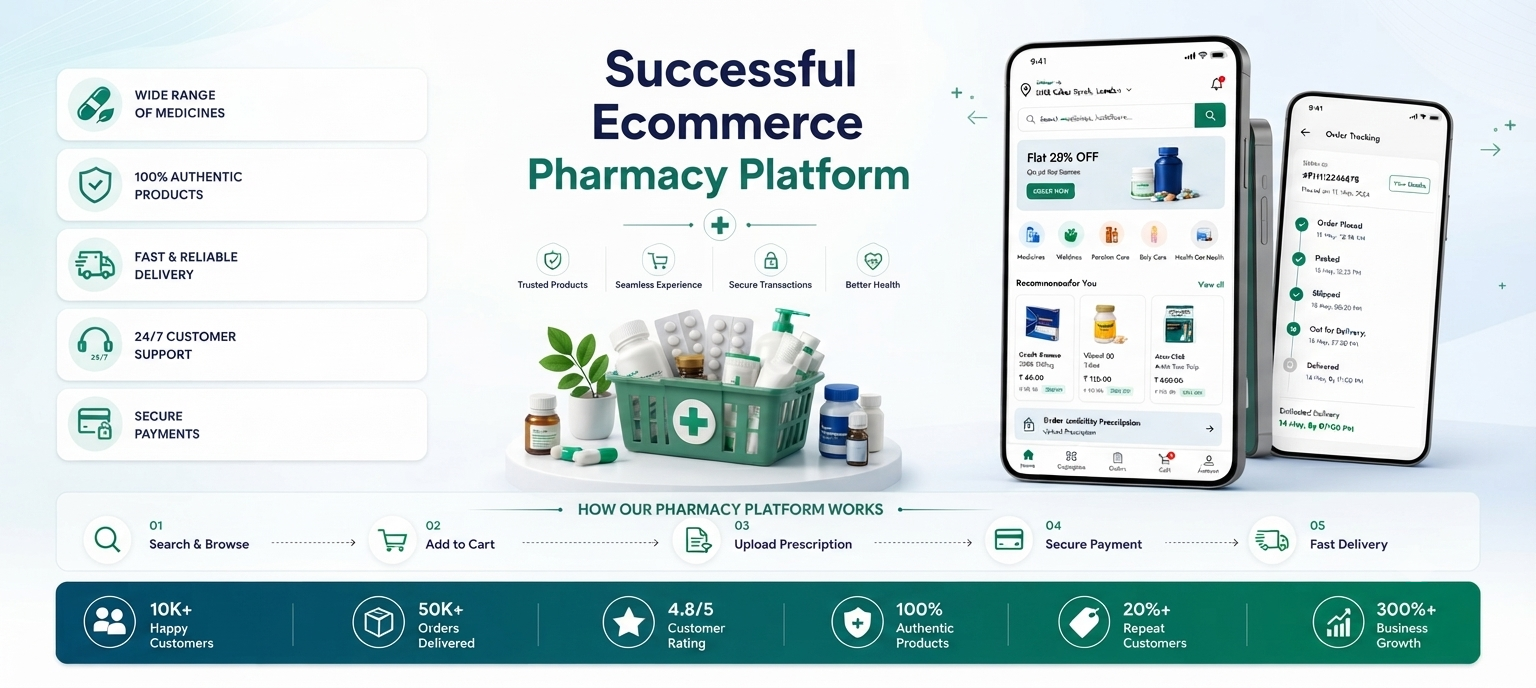
A pharmacy ecommerce platform is much more than a website where customers can buy medicines. It is a complete online platform that manages prescription verification, medicine inventory, payments, delivery, GST billing, and regulatory compliance while supporting day-to-day pharmacy operations.
A pharmacy — online or offline — has regulatory obligations that a generic ecommerce cart cannot handle.
What a generic cart cannot do:
- Verify prescriptions before processing a Schedule H or Schedule H1 drug order (prescription-only drug categories defined under Indian law)
- Track batch numbers and expiry dates across multiple SKUs (stock-keeping units — unique product identifiers)
- Apply GST (Goods and Services Tax) rates correctly across different drug categories
- Flag restricted drugs automatically
- Push stock updates across physical and online stores simultaneously
- Maintain the audit trail a Drug Inspector can review
A purpose-built online pharmacy platform handles all of this — because it is built for pharmacy operations, not general retail.
Why Every Pharmacy Needs an Online Ecommerce Platform in India
More pharmacies across India are investing in an online medical shop to meet changing patient expectations and stay competitive. As medicine ordering increasingly moves online, pharmacies that offer digital ordering, prescription uploads, and home delivery are better positioned to retain existing customers and attract new ones. The market data clearly reflects this shift.
Right now, online pharmacies represent only 5–10% of India's total pharmacy market (source: Statista, Online Pharmacy Market India, 2026). That means 90–95% is still offline. The shift is still early. Pharmacies that go digital now are not late — they are early.
Three things are driving this shift.
Smartphones and internet access have reached Tier 2 and Tier 3 cities in India. Patients in Lucknow, Coimbatore, and Surat are ordering medicines online. If your pharmacy isn't there, a national platform is.
Chronic disease is driving repeat purchases. Patients with diabetes, high blood pressure, or thyroid conditions need the same medicines every 30–60 days. An online shop with automatic refill reminders captures this recurring demand. A physical counter does not.
Hospital discharge is the highest-intent moment in the patient journey. A patient walking out with a prescription will order online within hours if a convenient option exists. Hospitals with their own ecommerce platform for pharmacies capture this at the point of care — not after the patient has already gone elsewhere.
Best Pharmacy Ecommerce Platform for Small Business: Who Needs It?
The platform looks different depending on who is running it. Here are the three most common use cases.
Hospital pharmacies
A hospital pharmacy already has a captive patient base — every discharged patient, every outpatient visit, every teleconsultation. An online medical shop connected to the hospital's information system means patients can order discharge medicines before they leave the ward, refill chronic prescriptions between visits, and get delivery at home. The doctor's prescription flows directly to the pharmacy without manual re-entry. Nothing gets lost. Nothing gets delayed.
Pharmacy chains
A chain running 10, 50, or 200 outlets needs centralised inventory visibility, consistent pricing, and one order management system that covers all locations. An online shop without this creates the worst of both worlds — orders arrive but stock is in the wrong branch. A platform built for chains syncs inventory in real time, routes orders to the nearest fulfilled branch, and tracks performance across locations in one dashboard.
Standalone pharmacies
A single pharmacy competing with national apps needs something the big platforms cannot offer — a direct relationship with the patient, a known face, and a trusted local brand. An online medical shop turns this into an asset. Patients can order from their local pharmacist, get WhatsApp order updates, and have medicines delivered by a familiar face. The platform is the infrastructure. The trust is already there.
For many local pharmacies, choosing an online ecommerce platform is one of the most affordable ways to compete with larger pharmacy marketplaces. Instead of building complex software from scratch, they can launch an online store with prescription management, payments, and delivery features already built in.
Essential Features of an Online Medicines Platform
Not every ecommerce feature matters for pharmacy. But these ones are non-negotiable.
Prescription upload and verification
Patients upload a prescription photo or PDF. A registered pharmacist reviews it before the order is dispatched. For Schedule H drugs (prescription-only medicines), this is a legal requirement under the Drugs and Cosmetics Act, 1940. Any platform that skips this step is creating compliance risk for the pharmacy owner.
Medicine catalogue management
Thousands of SKUs. Multiple brands per molecule. Different pack sizes. Substitutes to flag when a brand is out of stock. The catalogue needs to be easy to manage, with category structures your team can actually use — not a generic product database designed for clothing or electronics.
Real-time inventory sync
Online orders reduce stock. Offline walk-in customers also reduce stock. Both must update the same inventory in real time. A pharmacy that shows a product as available online when the physical shelf is empty loses a customer and creates a compliance issue.
GST billing and invoicing
GST rates on medicines are not uniform. Some drugs attract 5%, others 12%, some are exempt. OTC (over-the-counter, meaning no prescription required) health products have different rates again. The platform must calculate and apply the correct rate at SKU level and generate a GST-compliant invoice for every order. Manual GST handling at scale is an audit waiting to happen.
Payment options Indian patients expect
UPI (Unified Payments Interface), credit and debit cards, net banking, and cash on delivery. In many Tier 2 and Tier 3 markets, COD (cash on delivery) is still the preferred payment method. A platform that only accepts UPI will miss a large segment of patients.
Delivery workflow management
In-house delivery riders, third-party logistics partners, or patient self-pickup. The platform needs to support all three — with tracking visible to the patient and to the pharmacy team, and delivery proof captured for the audit trail.
Order tracking and customer communication
Patients expect to know where their order is. SMS, WhatsApp, and in-app updates for order confirmed, prescription verified, order dispatched, and delivery completed. Reorder reminders for chronic patients. These are not nice-to-haves — they are what reduce customer service calls.
Compliance and audit trail
Every prescription received, every drug dispensed, every batch number, every delivery — logged and searchable. Drug Inspectors under the Drugs and Cosmetics Act can request records at any time. A platform with a built-in audit trail makes this manageable. A paper-based record system does not.
Prescription Verification & Pharmacy Compliance in India
This is the part most ecommerce guides skip. It is also the part that matters most.
India's online pharmacy regulatory environment is complex. The Drugs and Cosmetics Act, 1940 (D&C Act), and the Drugs and Cosmetics Rules, 1945, apply to online drug sales — not just physical ones. A 2015 notice from the Office of the Drug Controller General of India (DCGI) confirmed this explicitly. Prescription drugs can only be dispensed by a registered pharmacist, and only against a valid prescription from a registered medical practitioner.
This creates a specific workflow requirement. When a patient orders a prescription medicine online:
- The patient uploads their prescription.
- A licensed pharmacist on your team reviews it.
- The pharmacist approves or rejects the order.
- Only approved orders proceed to fulfilment.
- The prescription and pharmacist approval are logged against the order record.
Platforms that skip or automate this step are operating in violation of the Drugs and Cosmetics Act. The Economic Times reported in 2025 that fake AI-generated prescriptions are being used to order controlled medicines online. Regulators are paying attention. Platforms with weak verification workflows are at risk.
A production-ready pharmacy ecommerce platform must handle this workflow natively — not as a workaround bolted on after the fact.
How an Online Medical Shop Increases Pharmacy Revenue
Most pharmacies think of an online shop as a new sales channel. It is that. But the revenue opportunity is bigger.
Subscription refills
Patients with chronic conditions refill the same prescription every 30–60 days. A subscription model — where the system automatically prompts, confirms, and dispatches the refill — converts a one-time transaction into predictable monthly revenue. This is what the large national platforms have built. A standalone pharmacy can offer the same.
OTC and wellness products
Once a patient is ordering online, the basket expands. Vitamins, supplements, skincare, baby care, diagnostics kits, and health devices are high-margin OTC products with no dispensing compliance requirements. These products increase average order value without adding regulatory complexity.
Corporate and employer accounts
Companies managing employee health benefits are looking for pharmacy partners who can supply chronic medicines, health supplements, and diagnostics kits on account. A pharmacy ecommerce platform with bulk ordering, e-invoicing, and GST compliance handles this cleanly.
Diagnostic and lab integration
A pharmacy that can also book a lab test gives patients a reason to come back to the same platform repeatedly. Pharmacy and diagnostics together is a strong stickiness model — the patient doesn't need to go anywhere else.
How to Launch an Online Medical Shop — Step by Step
Step 1 — Sort your licensing first
You need a valid drug license under Form 20 (for retail) or Form 21 (for wholesale) from your State Drugs Control Organisation. You also need a registered pharmacist on staff. The online shop extends your existing licence to the online channel. If you don't have a current licence, sort this before launch.
Step 2 — Build your medicine catalogue
Start with your top 500–1000 SKUs by volume. Add images, pack sizes, generic names, and substitute options. A clean 1000-item catalogue is better than a messy 5000-item one. Expand weekly once the shop is live.
Step 3 — Configure your prescription workflow
Decide who reviews prescriptions and when. Set up your approval queue. Define which categories require a prescription and which do not. Test the workflow end-to-end before accepting any real orders.
Step 4 — Set delivery zones and rates
Start with a 5–10 km delivery radius. Agree your delivery turnaround time — same-day or next-day for most orders. Define delivery fees clearly and configure them in the platform.
Step 5 — Set up payments and GST
Configure your payment gateway and GST rates per category before launch. A wrong GST rate on a live order creates reconciliation problems. Get this right in a test environment first.
Step 6 — Soft launch with existing patients
Before you run any marketing, invite your existing patients to order online. Give them a small incentive — free delivery for the first order, a small discount. This gives you real orders to test with, real feedback, and early reviews before you open up to new customers.
Step 7 — Promote at the point of care
A QR code at the pharmacy counter, on your prescription bags, and on patient discharge paperwork is more effective than paid advertising for a pharmacy. Your most valuable customers are already standing in front of you. Make it easy for them to switch to online ordering.
How to Choose the Best Pharmacy Ecommerce Platform
There are many pharmacy software vendors in India. Here is how to separate a production-ready platform from a product demo with a nice interface.
Does it handle prescription workflows natively?
Not as a manual queue managed over WhatsApp. An actual workflow inside the platform — prescription received, under review, approved, rejected — with the pharmacist's action logged against the order.
Is inventory management built in, or bolted on?
Batch tracking, expiry date monitoring, and multi-location stock visibility should be native features. If these are add-ons from a third-party tool, the integrations will break.
Can it connect to your hospital or clinic system?
If you run a hospital pharmacy, prescriptions from the in-patient system should flow directly to the online shop without re-entry. Ask for a live demo of this integration, not a screenshot.
Does it generate GST-compliant invoices automatically?
Ask to see an actual invoice generated by the platform. Check that it has your GSTIN (GST Identification Number), correct HSN (Harmonised System of Nomenclature) codes for medicines, and the right tax rates by category.
What does delivery management look like?
Assign riders, track deliveries, capture proof of delivery — all within the platform. If delivery is tracked in a spreadsheet, that is a process problem waiting to become a compliance problem.
What is the mobile experience like?
Your patients will order from their phones. Test the ordering experience — product search, prescription upload, payment, order tracking — on an Android device, since that is the primary device for most Indian patients.
What does post-go-live support look like?
Catalogue updates, GST rate changes, new payment integrations, compliance updates — these will happen after launch. Ask how the vendor handles them before you sign.
Not every ecommerce solution is designed for regulated healthcare businesses. The best online ecommerce platform for pharmacies should support prescription verification, inventory management, GST billing, payment integration, and compliance without relying on third-party workarounds.
CSoft Pharmacy Ecommerce Platform — Built for Healthcare Operations
CSoft Online Medical Shop is not a generic ecommerce platform. It is built on the same foundation as CSoft HIMS — so hospital pharmacies get direct integration with patient records, prescriptions, and discharge workflows from day one.
Here is what the platform includes:
Prescription upload and verification
Patients upload prescriptions through the app or web. A pharmacist reviews and approves before any Schedule H drug is dispatched. The approval is logged against every order.
Medicine catalogue management
Medicines, supplements, and healthcare products set up with categories, substitutes, pricing, and availability — managed from one place across online and offline channels.
Real-time inventory and stock management
Batch tracking, expiry date alerts, and multi-location stock visibility. Online orders and walk-in sales update the same stock record.
Order processing and tracking
Orders move through a clear processing workflow with status visible to both your team and the patient.
Payment gateway integration
UPI, cards, net banking, and cash on delivery. The payment gateway of your choice, integrated as part of the platform setup.
GST billing and invoicing
GST calculated and applied correctly at SKU level. Compliant invoices generated automatically for every order.
Delivery workflow management
In-house riders, delivery partners, or both. Assignment, tracking, and delivery confirmation built into the platform.
Customer communication and reorders
Order updates, prescription reminders, and reorder prompts sent via SMS and WhatsApp. CSoft Voice Agents can make automated refill calls for chronic patients who haven't reordered on schedule.
CSoft Patient Wallet supports prepay and account-based payment models — useful for corporate accounts and subscription refill programmes.
When billing and insurance claims are in scope, CSoft RCM Automation connects pharmacy revenue to the broader hospital billing workflow — so pharmacy revenue doesn't get siloed from the rest of the organisation's financial reporting.
For hospital pharmacies that also manage lab orders, CSoft LIMS / Pharma Labs connects the pharmacy and lab workflows — so a patient can order medicines and book a test from the same app.
The platform is custom-configured to your model — hospital pharmacy, chain, or standalone — with the delivery zones, GST setup, payment gateway, and inventory structure that fits your operation.
Why 2026 Is the Right Time to Launch an Online Medical Shop
The online pharmacy market in India is growing fast. The national platforms — Netmeds, 1mg, PharmEasy — are spending heavily on Tier 2 and Tier 3 market acquisition. They are not waiting.
Hospitals and pharmacy chains that build their own pharmacy ecommerce platform now keep the patient relationship on their terms. They are not dependent on a national platform's algorithm, pricing policy, or delivery network. They own the channel.
Standalone pharmacies that go digital now serve the same patient more conveniently — and stop losing them to platforms that are faster to load than to walk to.
The window is open. In 24 months, the habits of online medicine ordering will be set. The pharmacies that are already there will have the customer base. The ones that wait will spend years trying to win it back.
Ready to Take Your Pharmacy Online?
If you're searching for the best online ecommerce platform India pharmacies can depend on, CSoft provides everything required to launch and manage a secure, compliant, and scalable online medical shop.
We configure your catalogue, test your prescription workflow, and go live with a clean soft launch before full rollout.