
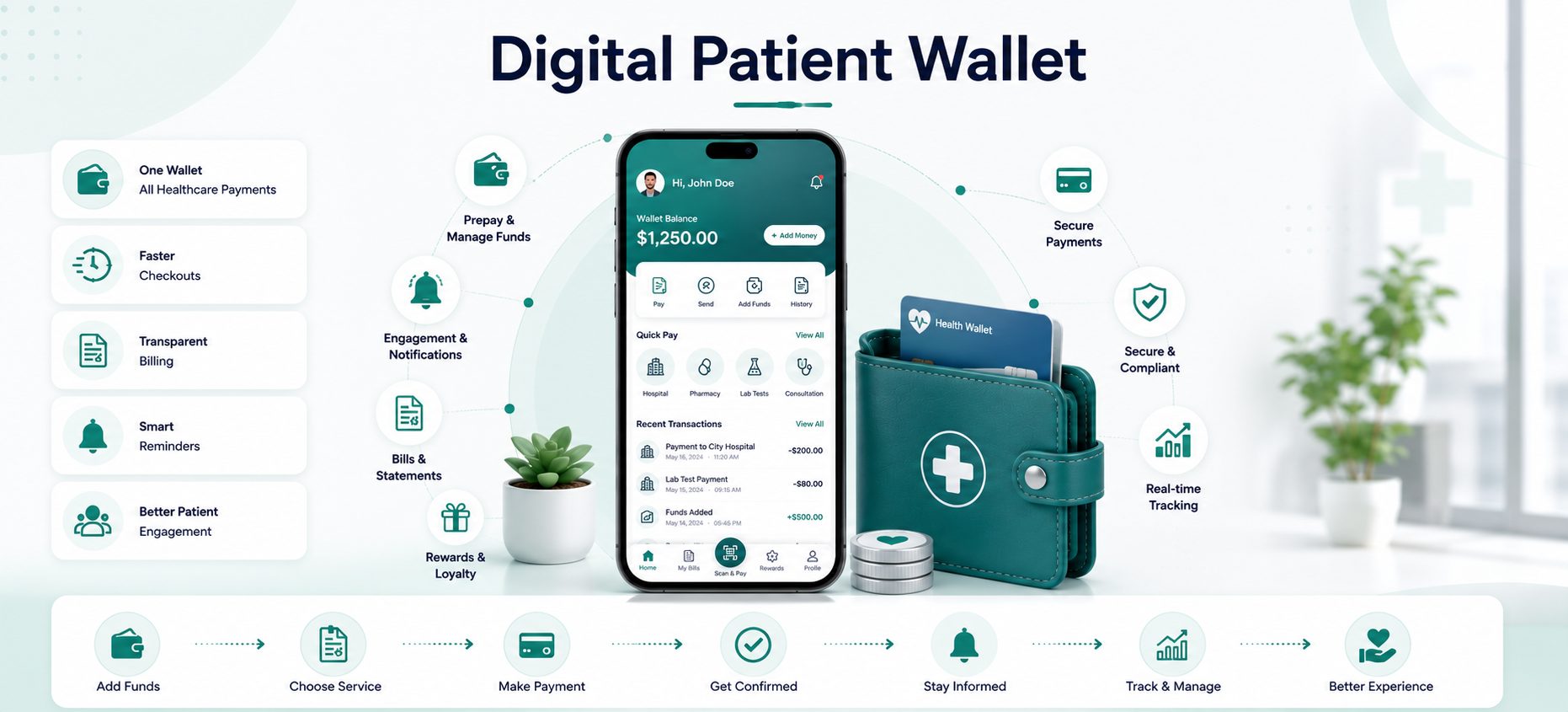
Patients already pay for groceries, fuel, and food delivery with a tap on their phone. Hospital bills are often the one place where they still queue at a counter, hand over cash, or wait for a printed receipt. A digital patient wallet closes that gap. It gives patients one place to pay medical bills, track medical expenses, and store health records, while giving hospitals faster, cleaner collections.
This guide covers what a patient wallet actually does, why hospitals in India and the GCC are moving toward this model, and how a hospital can build one without ripping out its existing billing system.
A patient wallet turns hospital billing from a source of friction into a source of trust — one balance, one history, and no surprises at discharge.
What Is a Digital Patient Wallet?
A digital patient wallet is a payment account tied to a patient's profile inside a hospital's system. It sits at the crossing point of healthcare and fintech — part payment app, part medical record, part billing tool.
Instead of paying separately at every counter — OPD, pharmacy, lab, admission desk — the patient uses one balance and one payment history across visits. It is not a loyalty gimmick bolted onto a website. Done properly, it is billing infrastructure: a record of what was paid, when, and through which method, linked directly to the hospital's actual charges.
Why Hospitals Need a Digital Patient Wallet in 2026
A few shifts are pushing hospitals toward digital wallets faster than expected:
- Patients already expect it. Research on healthcare payments shows most patients now prefer providers that offer digital payment options over cash-only counters, and a large share still feel uneasy handling shared payment devices at a counter.
- Government infrastructure is normalizing it. India's Ayushman Bharat Digital Mission has expanded wallet and balance-tracking features inside government health apps this year, and the new Unified Health Interface is built to work the way UPI works for payments. Patients are being trained, at a national level, to expect a wallet view of their healthcare.
- Cash-heavy counters leak revenue. Wrong change, missed charges, and delayed deposits are hard to catch when money moves manually. A wallet-based flow leaves an auditable trail for every rupee collected.
- Multi-branch hospital groups need one patient, one balance. As chains expand across cities, patients expect their balance and history to follow them, not reset at every branch.
Contactless Check-In and Onboarding
A patient wallet works best when it starts before the patient even reaches the counter. Contactless patient check-in — scanning a QR code, verifying identity, and confirming appointment details from a phone — cuts front-desk queues and reduces the paperwork staff have to re-enter by hand.
Pairing contactless onboarding with the wallet means a returning patient can walk in, check in digitally, and settle their OPD fee before they even sit down in the waiting area.
Key Features of a Digital Patient Wallet App
From the patient's side, a good health wallet app should feel simple. The core actions patients want are:
- Pay medical bills online securely — UPI, cards, net banking, or wallet balance, without re-entering payment details every visit.
- Track medical expenses — a running view of what was spent across OPD visits, pharmacy, labs, and procedures.
- Store health records and prescriptions — a digital prescription saver so patients don't lose paper slips between pharmacy refills.
- Carry a medical ID wallet — key details like blood group, allergies, and emergency contacts, accessible quickly if needed.
- Manage family profiles — one payer managing balances and records for dependents, useful for paediatric and elder care.
Getting Cost Estimates Before Surgery
One of the most common patient questions before a planned procedure is simple: what will this actually cost? A wallet-linked billing system can generate a cost estimate before surgery, based on the package, room category, and known procedure charges, so patients aren't blindsided at discharge.
This also helps hospitals collect prepay deposits with confidence, since the patient has already seen a transparent estimate rather than an open-ended number.
Managing Insurance Copays and Deductibles with a Patient Wallet
For insured patients, the biggest source of confusion is usually the gap between what insurance covers and what they owe out of pocket. Healthcare copay software built into the wallet can show:
- Coverage and estimated co-pay before a service is billed
- Automated copay collection at the point of care, instead of manual follow-up later
- A way for families to track their health insurance deductible across multiple members and visits
This depends on the insurance and TPA data a hospital already receives, but even a partial view — showing estimated patient responsibility upfront — reduces billing disputes significantly.
Why Your Digital Patient Wallet Should Integrate with Hospital Billing Software
A payment wallet disconnected from actual hospital billing quickly turns into a second set of books someone has to reconcile by hand. For a wallet to work as real medical billing software rather than a side app, it needs EHR payment integration — sitting close to the billing engine, not bolted on top of it.
- Charges post from the hospital's HIMS so wallet balances always reflect real bills, not a parallel estimate.
- Payments auto-allocate against open bills instead of sitting as unassigned credit.
- During an IPD stay, deposits are consumed in real time as charges are added.
- Refunds follow a clear policy — back to wallet, or back to the original payment method — and that policy stays trackable for audit.
For hospitals already using CSoft's HIMS, or running pharmacy and telemedicine billing through the same ecosystem, a wallet workflow can share the same patient ID, so a patient sees one balance, not three separate apps to check.
A wallet that doesn't talk to your billing engine isn't a wallet — it's just a second ledger someone has to reconcile by hand.
ABHA Integration: Linking India's Health ID to a Patient Wallet
For hospitals in India, a growing and practical question is how to link a patient's ABHA card to their health wallet. ABHA (Ayushman Bharat Health Account) is becoming the standard patient identifier across India's digital health system, and government platforms are already showing wallet and policy information tied to it.
A wallet workflow can be built as ABDM compliant scan and pay hospital software — verifying a patient through their ABHA ID at check-in, then linking that same ID to their payment and billing history inside the hospital's system. This keeps the hospital aligned with national digital health standards while giving patients a familiar, government-recognized identity layer.
Flexible Medical Payment Plans Through a Digital Patient Wallet
Not every patient can settle a large bill in one go, especially for planned surgeries or extended treatment. Hospitals are increasingly asked to manage medical bills with flexible monthly payments — splitting a package cost into instalments tied to treatment milestones rather than one lump sum at discharge.
Built into a wallet, this becomes a structured feature rather than an informal arrangement between the billing desk and the patient: a visible instalment schedule, automatic reminders, and a running balance the patient can track.
How a Patient Payment Solution Reduces Hospital Accounts Receivable
For hospital finance teams, the real payoff of a wallet system shows up in accounts receivable. When prepay and digital settlement are done right:
- Planned procedures get funded before service delivery, improving cash position going into surgery or admission.
- QR-based payment at OPD exit points reduces the load on central billing counters.
- Corporate patients get clean digital receipts they can use for HR reimbursement claims without chasing paperwork.
- Multi-city chains give patients a balance that follows them between branches, a real differentiator against single-location competitors.
Wallet reminders can also be paired with tools like AI voice agents to call patients ahead of elective admissions when their balance is running low, instead of surprising them at the front desk.
Security and Data Protection
A few things matter regardless of how the wallet is scoped:
- Card data should run through PCI-aligned payment gateways, never stored directly on hospital servers.
- Wallet balances need to be treated as a liability in finance ledgers, not free-floating credit.
- Hospitals serving overseas or medical-tourism patients should align with recognized international data security standards, alongside India's DPDP Act or the relevant GCC data protection framework for local patients.
- Printed receipts should still be available for patients who need them. Going digital-first doesn't mean going digital-only.
How CSoft Builds a Healthcare Payment Platform for Hospitals
CSoft does not sell a fixed, one-size-fits-all wallet app. Hospitals have different billing rules, different payment gateways already in place, and different patient volumes. A generic wallet product rarely fits cleanly into any of them.
Instead, patient engagement and digital wallet workflows are scoped as a custom extension, built on top of CSoft's existing HIMS, telemedicine, and pharmacy ecommerce foundations. A typical engagement covers:
- A scoping study to map how your patients currently pay and where the friction is.
- A defined first phase, usually core payment visibility and settlement, before expanding into reminders, family accounts, or loyalty features.
- Security built around encryption, tokenized payment handling, and established payment gateways, aligned to the regulations in your market.
- A single view of what's paid, pending, and owed across the facilities and services you choose to include.
This roadmap-led approach means a hospital doesn't need a big-bang rollout. Core payment visibility can go live first, with copay tracking, ABHA linking, and loyalty features layered in once the payment workflow is proven.
How to Implement a Digital Patient Wallet in Your Hospital
Hospitals that succeed with this tend to start narrow and expand deliberately:
- Phase 1 — pilot digital settlement and contactless check-in at one branch or one high-traffic OPD counter; train staff to explain the wallet to patients.
- Phase 2 — extend prepay and cost estimates to surgery and package-based departments, such as maternity or orthopaedics.
- Phase 3 — roll out chain-wide, with copay tracking, ABHA linking, and flexible payment plans added once the core workflow is stable.
Track adoption rate, average wallet balance, counter wait times, and bad-debt reduction on elective cases to know if the rollout is working.
How a Digital Patient Wallet Improves Patient Engagement
Once patients have a funded account and a habit of using it, hospitals can build on that relationship. This is where a payment tool grows into a true patient engagement platform — surfacing remote patient monitoring subscriptions, health package renewals, or pharmacy refill credits through the same wallet touchpoint. The payment layer becomes the starting point for an ongoing relationship, not just a transaction.