
Ramesh is 58 years old. He had a cardiac event and was discharged from a hospital in Pune. His discharge summary had his medicines and a follow-up appointment six weeks away.
By week three, his blood pressure was climbing. But no one knew. He ended up back in the emergency room.
His cardiologist said it later — the readmission was preventable. If someone had seen the trend just three days earlier, they could have adjusted his dose over the phone.
That gap — between discharge and the next clinic visit — is where chronic disease quietly gets worse.
Remote patient monitoring (RPM) software closes that gap.
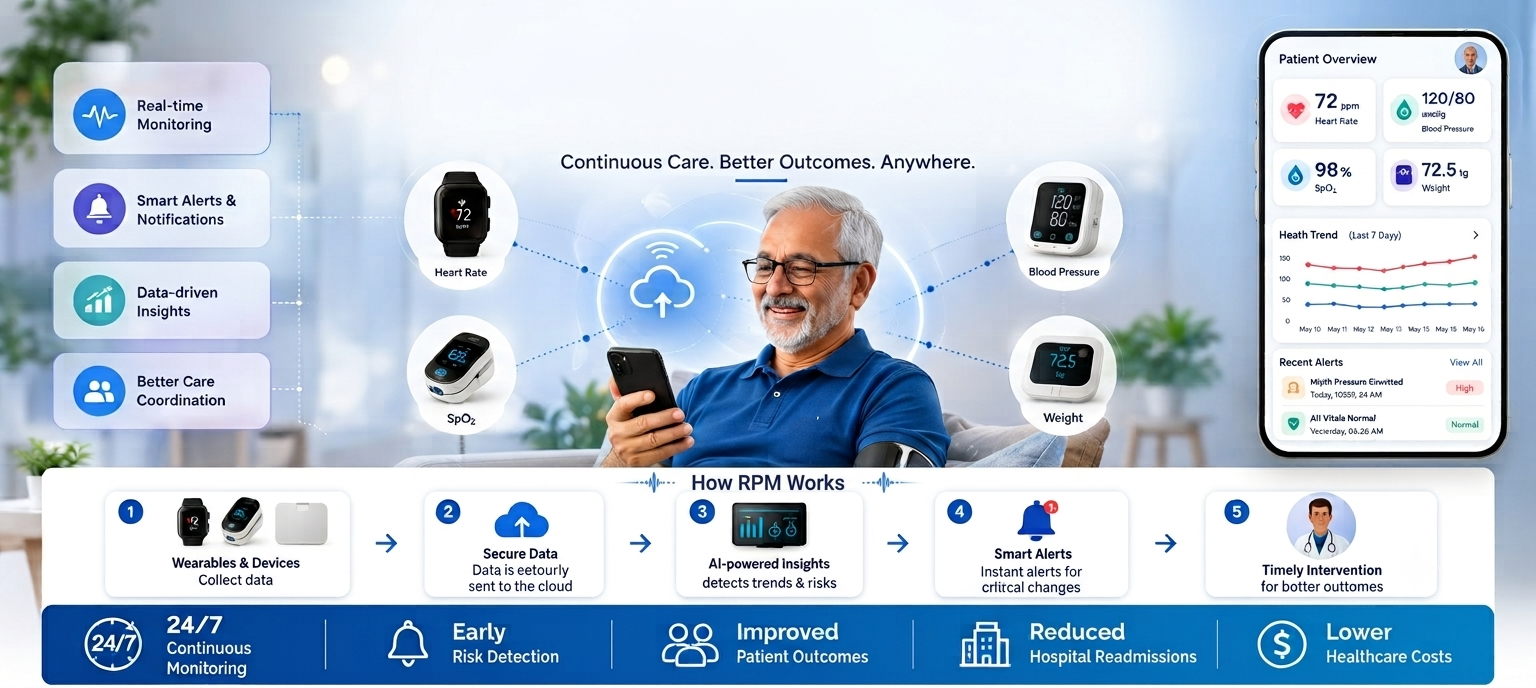
With RPM software, patients check their vitals at home using simple connected devices. The readings — blood pressure, blood sugar, oxygen levels, weight — go straight to the hospital. The clinical team watches the data in real time. If something looks wrong, the software flags it. The nurse calls. The doctor adjusts. Ramesh doesn't end up in the emergency room again.
Why Remote Patient Monitoring Software Is Becoming Essential for Indian Hospitals
This is not a future problem. It is happening right now.
Non-communicable diseases — heart disease, diabetes, high blood pressure, lung disease, kidney disease — cause 61.8% of all deaths in India (source: National Library of Medicine). About 21% of elderly Indians have at least one chronic condition. Hypertension and diabetes together account for 68% of all chronic diseases in that age group (source: PLOS ONE).
Most of these patients visit a hospital once every 4–8 weeks. Between visits, no one knows what's happening at home. Blood pressure goes uncontrolled. Medicines get skipped. The first sign of trouble is an ambulance call.
The market is responding. India's RPM market was worth $1.08 billion in 2024 and is expected to reach $7.55 billion by 2035 — growing at 19.3% per year (source: Market Research Future, India Remote Patient Monitoring Market Report, 2025).
Hospitals investing in remote patient monitoring software now are not chasing a trend. They are building what chronic care actually needs.
What Is Remote Patient Monitoring Software and How Does It Work?
Remote Patient Monitoring (RPM) software helps hospitals deliver continuous care by allowing patients to share their health data from home. It enables care teams to:
- Monitor patient health using connected medical devices.
- Receive vital signs such as blood pressure, blood sugar, oxygen levels, and weight.
- Get alerts when readings fall outside the normal range.
- Review patient data remotely and provide timely care.
- Reduce unnecessary hospital visits while improving patient outcomes.
The process typically follows these five stages.
Top Medical Conditions That Benefit from Remote Patient Monitoring Software
Not every patient needs RPM. The strongest results come from these conditions:
Post-discharge cardiac patients
Heart failure, post-heart attack, and post-procedure patients face the highest risk in the 30 days after discharge. Daily weight and blood pressure readings catch fluid build-up and pressure changes before they become readmissions. This is the most common starting point for hospital RPM programmes.
High blood pressure
Patients whose blood pressure is not coming down despite regular medication visits need more data than one monthly reading. Home monitoring over 2–4 weeks gives doctors a real picture — does the pressure spike in the morning? Only in the clinic? At night? That picture allows better medicine adjustment.
Diabetes
Blood sugar trend data between visits changes diabetes management from reactive to proactive. For patients on insulin, this is especially important. One missed reading can be the difference between a dose adjustment and a dangerous low.
Post-surgical recovery
Patients recovering at home after orthopaedic, general surgery, or cancer treatment need monitoring for signs of infection, unstable vitals, and missed medication. Early detection prevents emergency readmissions.
High-risk pregnancy
For gestational hypertension (high blood pressure during pregnancy) and pre-eclampsia monitoring, home blood pressure tracking reduces emergency presentations and allows timely action.
COPD — Chronic Obstructive Pulmonary Disease
Oxygen level monitoring for patients with COPD (a lung condition that makes it hard to breathe) identifies worsening episodes early — often 48–72 hours before the patient feels they need to go to hospital. Acting in that window prevents emergency admissions.
How Remote Patient Monitoring Software Works: Step-by-Step Process
A well-run RPM programme has five stages.
Stage 1 — Enrolment
The care team identifies the right patients — post-discharge cardiac, uncontrolled diabetics, high-risk pregnancies, or lung disease patients with recent episodes. Enrolment happens at or before discharge — not as an afterthought. The patient gets their device, a short demonstration, and is added to the monitoring dashboard in the software.
Stage 2 — Readings come in automatically
Readings sync to the software daily — blood pressure, blood sugar, weight. The patient doesn't enter numbers manually. The device handles the upload.
Stage 3 — Alerts fire when needed
The software flags missed readings, threshold breaches, or worsening trends. The right person — a nurse, care manager, or specialist — gets notified. Not every alert goes to the doctor. Most go to the nurse, who reviews and escalates only what needs clinical attention.
Stage 4 — Remote action is taken
The nurse calls the patient, reviews the trend, and acts — adjusting medicine, setting up a video call, ordering a lab test, or arranging an early visit. This happens the same day, not at the next scheduled appointment.
Stage 5 — Everything is documented
Every review, every call, every intervention goes back into the patient's record inside the software. The doctor seeing the patient at week six sees the full picture of what happened at home — not just the discharge summary and today's vitals.
Benefits of Remote Patient Monitoring Software for Hospitals and Patients
The results from remote patient monitoring software are well documented.
Fewer readmissions
Post-discharge RPM for heart failure patients has shown 38–50% reductions in readmissions compared to standard discharge care (source: The Permanente Journal, 2025, and the FirstNet RPM case study on heart failure).
Better blood pressure control
Structured home blood pressure monitoring with clinical feedback improves hypertension control. At-scale home monitoring programmes have freed up hundreds of thousands of primary care appointments — because patients whose blood pressure is managed remotely need fewer urgent walk-in visits (source: News18, September 2025).
Better diabetes outcomes
Regular blood sugar monitoring and data review improves long-term blood sugar control — measured by a test called HbA1c (Haemoglobin A1c), which shows an average of blood sugar over 2–3 months. Patients whose readings are being watched adjust their diet, medication timing, and activity in ways that clinic check-ins alone don't achieve.
Fewer emergency visits
Lung disease patients on oxygen monitoring with proactive outreach show 30–40% fewer emergency presentations — because episodes are caught and treated earlier (source: Global Initiative for Chronic Obstructive Lung Disease, GOLD Report, 2024).
Higher patient satisfaction
Patients enrolled in RPM report feeling more supported between appointments. They feel monitored — not abandoned after discharge. Medication adherence goes up too.
How to Choose the Right Remote Patient Monitoring Software for Your Hospital
Not all remote patient monitoring software solutions are the same. There are two broad options for hospitals in India.
Ready-made RPM software
These are off-the-shelf solutions with standard features — device integrations, dashboards, alert rules, and basic reporting. They are quicker to deploy and easier to budget. They work well for hospitals starting with one condition and a clear protocol. Most hospitals in India begin here.
Custom remote patient monitoring software
Some hospitals need software built around their specific workflows — their alert rules, their device mix, their patient records system, their patient population. This is where custom remote patient monitoring software development makes sense. A custom-built solution takes longer and costs more upfront, but it fits the hospital's clinical model exactly. Larger networks and specialty hospitals — cardiac centres, diabetes clinics, maternal health programmes — often find this more effective long term.
What to avoid
Avoid software built entirely for Western markets — designed around insurance billing codes and health systems that don't map to India. These solutions often have connectivity issues, poor local device support, and no pathway for customisation. The best RPM software for Indian hospitals is built with local workflows in mind, or is custom-configured for them.
CSoft Remote Patient Monitoring Software for Indian Hospitals
Effective remote patient monitoring is more than collecting health data. The real value comes from connecting patient readings with the hospital's existing clinical workflow. Vital signs, alerts, teleconsultations, and follow-up actions should all be available within the same patient record, giving clinicians a complete view of the patient's health without switching between multiple systems.
CSoft is a best remote patient monitoring software provider in India, offering affordable pricing that works for hospitals of all sizes — from single-specialty clinics to large multi-site networks. CSoft RPM / Virtual Care is built on CSoft's Telemedicine and HIMS platform, allowing remote monitoring, video consultations, scheduling, and patient records to work together in a single connected system.
CSoft is known for offering remote patient monitoring software at an affordable pricing — with no large upfront licence fees and a pilot-first approach so hospitals see results before full deployment. The software is fully Android-compatible, with a patient-facing Android app designed for easy use by elderly patients and a care team dashboard that works on any Android device or web browser.
The software is also custom-configurable — alert thresholds, escalation rules, device integrations, and reporting are all set to your hospital's clinical protocols, not locked to a generic template.
Remote vitals, teleconsult notes, and clinic records all live in one place inside CSoft HIMS.
When a patient skips three days of readings, a CSoft Voice Agent makes an automated outreach call — no staff member has to remember who to follow up with. When billing is in scope, CSoft RCM Automation captures the revenue from monitoring visits so it doesn't fall through the cracks.
Best Practices for Implementing Remote Patient Monitoring Software
The hospitals that succeed with RPM start with one condition and one patient group. Not everything at once.
Step 1 — Pick the right starting group
Post-discharge heart failure or uncontrolled high blood pressure are the clearest starting points. Return on investment is measurable within 60–90 days. Readmission rates before and after are easy to track.
Step 2 — Agree the rules before launch
Who qualifies? What devices do they get? What are the reading schedules? What triggers an alert? Who responds? Agree all of this with your clinical team before the first patient is enrolled — not during operations.
Step 3 — Choose devices your patients can actually use
Pick devices cleared by India's medical device regulator, CDSCO (Central Drugs Standard Control Organisation), or internationally cleared devices (FDA or CE marked). Pair them with a patient app that's simple enough for a 65-year-old with limited smartphone experience. Pilot with 5–10 patients at home before ordering for 200.
Start with a small group of patients and clear clinical workflows. Once the RPM programme is running successfully, you can gradually expand it to more specialties and patient groups.
Key Features to Look for in Remote Patient Monitoring Software
If you're comparing remote patient monitoring software providers, here are the questions that separate serious solutions from dashboards dressed up in medical branding.
Does it connect to your existing patient records?
If the RPM software is a separate system with no connection to your records, your team manages two sources of truth. That creates errors and clinical gaps. The best remote patient monitoring software connects directly to your hospital information system.
What devices are pre-integrated?
Ask for a list of specific device models the software has tested — not just "supports Bluetooth devices." The integration matters. So does reliability over 30 days of real-world use.
How are alerts managed?
Who gets notified, when, and through which channel — this must be configurable to your clinical protocols, not locked to a generic template. A one-size-fits-all alert system either floods clinicians or misses critical events.
Is there a good Android app?
In India, Android is the primary platform for both patients and care staff. Any remote patient monitoring software without a solid Android app creates friction that hurts compliance. Ask for a live demo on an Android device before you commit.
What does the patient experience look like?
Show the patient app to someone who isn't tech-savvy. If they can't figure out how to upload a reading without help, your enrolment completion rate will be poor.
Is the pricing affordable and transparent?
Affordable remote patient monitoring software shouldn't mean hidden costs. Ask for full pricing upfront — software licence, device costs, implementation, training, and ongoing support. Make sure the model works at your scale.
What does support look like after go-live?
Device replacement, connectivity issues, alert calibration after a few weeks of real data — these are real problems. Ask how the software provider handles them before you sign.
2026: Remote Patient Monitoring Is Becoming Part of Standard Care
Remote patient monitoring is no longer limited to early adopters. Hospitals across India are increasingly using RPM to strengthen post-discharge care, manage chronic diseases, and reduce avoidable readmissions.
As healthcare becomes more connected, continuous monitoring is becoming a natural extension of hospital care rather than an optional add-on. Hospitals that invest in the right technology, clinical workflows, and patient engagement strategies today will be better prepared to deliver coordinated, outcome-focused care in the years ahead.
Ready to See What RPM Software Can Do for Your Hospital?
CSoft is among the leading remote patient monitoring software providers in India, offering affordable remote patient monitoring software solutions built specifically for Indian hospitals, clinics, and healthcare networks.
CSoft RPM / Virtual Care is delivered as a scoped pilot — built on our Telemedicine and HIMS foundations, configured to your conditions, devices, and clinical workflows.
We start with one condition and one patient group. We agree the devices, alert thresholds, and staffing plan before launch. We measure outcomes at 60 and 90 days and expand only when the evidence supports it.