
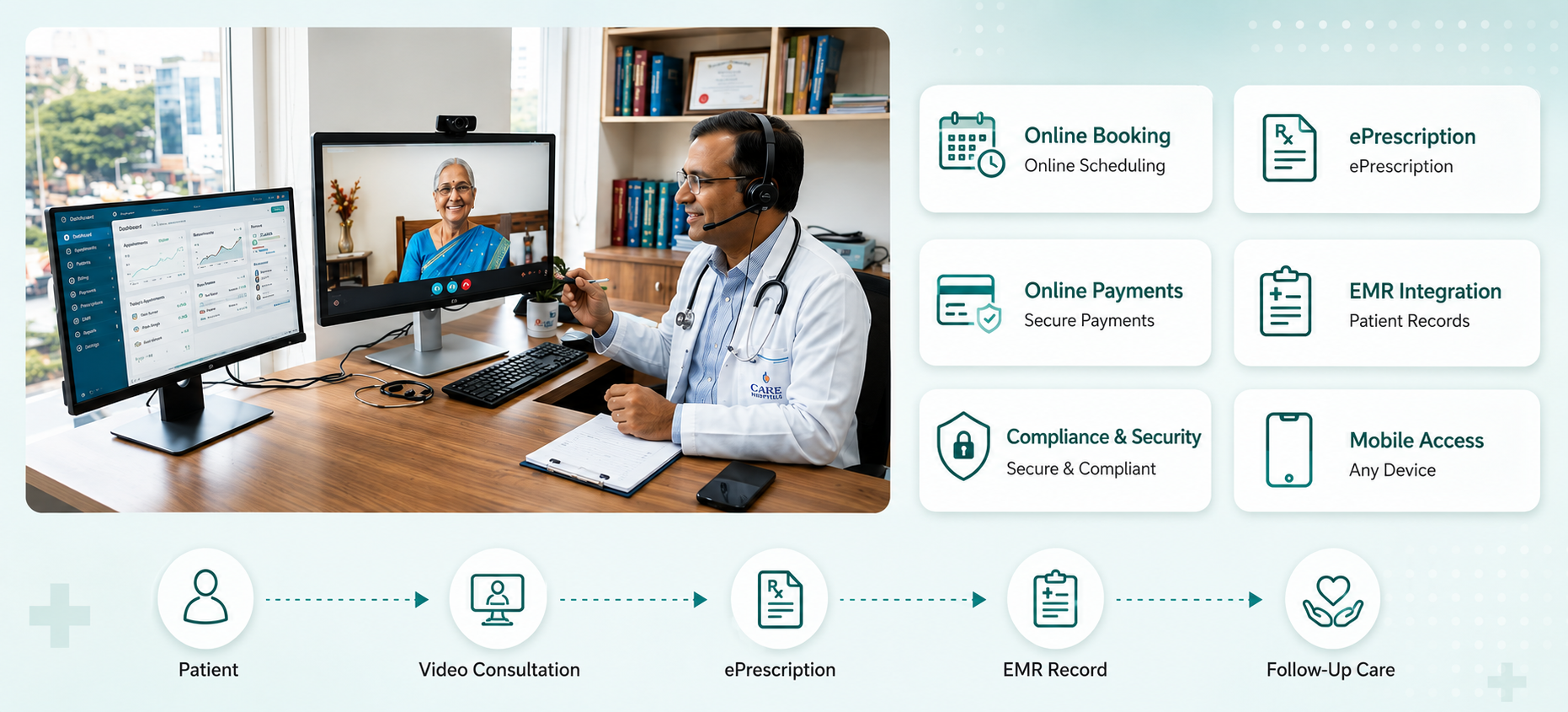
Meet Rajesh. He lives in Indore and needed to see a heart specialist. The nearest good hospital was a four-hour train ride away. Getting an appointment there would have taken a whole week. But his local hospital had a better option — a virtual appointment that same evening. Rajesh joined a video call, got his prescription on his phone, paid through UPI, and his visit was saved in his medical file — just like an in-person appointment. No travel. No waiting. No stress.
That is what a good telemedicine platform looks like in real life.
"Patients do not want just a video call. They want a complete visit — a receipt, a prescription, a follow-up date, and a doctor who can see their last reports."
— Medical Director, Tier-2 Hospital Group, Madhya Pradesh
In 2026, telemedicine platform India usage has grown from a temporary solution during the pandemic to a permanent part of how hospitals work. Hospitals across India and the GCC now treat virtual care as a serious part of their business — not a side feature they added during COVID and forgot about.
What Is a Telemedicine Platform?
If you have searched "what is telemedicine platform," here is the simple answer: it is software that lets a patient and a doctor have a full medical visit online. No need to travel to a hospital. No waiting in a queue. The patient books a time, talks to the doctor over video, gets a prescription on their phone, pays online, and has the visit saved in their medical record — all from one place.
An online telemedicine platform allows patients to get medical help from the comfort of their home. They can book an appointment, talk to a licensed doctor, receive a prescription, and have everything automatically recorded — without visiting a hospital even once.
Here is an important point: a simple video call on WhatsApp is NOT a telemedicine platform. Why? Because it has no record of the visit, no prescription system, and no payment. A real telemedicine platform ties everything together — booking, video, prescriptions, payment, and medical records — into one smooth system that a hospital can use as a proper care channel.
Think of the difference this way. A phone call can connect two people, but it is not a hospital. Similarly, a video call can connect a patient and a doctor, but it is not a telemedicine platform.
Telemedicine Platform Features: What a Good Platform Must Have
Not all telemedicine tools are the same. A basic video call app is very different from a full telemedicine platform. When choosing one for your hospital, here are the telemedicine platform features you should look for:
- Stable Video Calls — The video should work smoothly on mobile phones and computers, even in areas with average internet speed. This matters especially in Tier-2 and Tier-3 cities.
- Easy Appointment Booking — Patients should be able to book a slot easily. The system should sync with the doctor's calendar and the hospital's OPD schedule, and send automatic reminders so patients do not forget.
- Digital Prescriptions — The doctor should be able to write and send a prescription during or right after the call. The patient gets it on their phone, and it can be sent directly to a pharmacy. The prescription format should follow India's Telemedicine Practice Guidelines.
- Online Payment — Patients should be able to pay using UPI, debit/credit cards, or digital wallets — before or after the consultation — and receive an instant receipt.
- Report Sharing — Patients should be able to upload their old test reports and scans before the appointment. The doctor reviews them before or during the call.
- Connection to Hospital Software (HIMS/EMR) — The virtual visit record should go into the same system as in-person visit records through your Hospital Information Management System (HIMS). No separate files. No double work.
- Notifications in Multiple Languages — Appointment reminders and updates should reach patients through SMS, WhatsApp, or email, in the language they are most comfortable with.
- Consent and Identity Verification — Before every consultation, the platform should automatically collect the patient's ID and consent. This is required under India's telemedicine rules.
- Your Hospital's Branding — The app and prescriptions should show your hospital's name and logo — not the name of a third-party software company.
- Admin Reports and Dashboard — Hospital managers should be able to see how many consultations happened, how much revenue came in, how many patients did not show up, and more — all in real time.
How a Telemedicine Platform Works — In Simple Terms
A telemedicine platform is made up of several parts that work together. Think of it like a building — different floors doing different jobs, but all connected.
- Patient App — This is what the patient uses. They download it on their phone or open it in a browser. They can book appointments, join video calls, pay, and check their past prescriptions.
- Doctor Dashboard — This is what the doctor sees on their screen. They can check which patients are waiting, read patient history before the call starts, write notes, and send prescriptions — all from one screen.
- Secure Video Engine — The video call system is fully encrypted. That means no one else can listen in. It is built to stay stable even on slower internet connections.
- Integration Layer — This is the behind-the-scenes connector. Using an Interoperability Hub, it links the telemedicine platform to your hospital software, pharmacy system, payment gateway, laboratory systems, insurance platforms, and messaging channels like SMS and WhatsApp.
- Data and Security System — All patient information is stored safely with strong encryption. Every action is recorded in an audit log, and only authorised staff can access what they are allowed to see.
- Admin and Reports Panel — Hospital management can track everything — how many virtual OPD slots were used, how much revenue was collected, which doctors have the highest no-show rates, and more.
Hospital groups with more than one branch usually use a shared setup — one system at the back, but each branch has its own look and feel for patients. This makes it much faster and cheaper to launch telemedicine across multiple locations without building everything separately each time.
Is a HIPAA Compliant Telemedicine Platform What You Actually Need?
You may have heard the term "HIPAA compliant" used to describe secure health software. HIPAA stands for Health Insurance Portability and Accountability Act — and it is a United States law. It sets rules for how patient data must be protected.
Many software companies use "HIPAA compliant" as a way to say their platform is secure. That is fine as a starting point. A HIPAA compliant telemedicine platform should have encrypted video calls, encrypted data storage, proper audit records, and limited access based on who the user is. These are good security basics for any country.
But if your hospital is in India or the GCC, HIPAA alone is not enough. You need to meet the local rules that actually apply to you.
India
- Telemedicine Practice Guidelines (2020) — These are rules set by the Indian government that cover how patient identity must be verified, how consent must be taken, and how prescriptions must be written in a telemedicine setting.
- Digital Personal Data Protection Act (DPDP), 2023 — This is India's new law on how personal data — including patient health data — must be collected, stored, and protected.
- ABDM and ABHA Integration — Ayushman Bharat Digital Mission (ABDM) is India's national health ID programme. As adoption grows, hospitals are expected to link patient visit records to ABHA health IDs.
- NABH Telemedicine Standards — Hospitals seeking NABH quality accreditation must also meet telemedicine-specific standards as part of their certification.
GCC
- MOHAP, DHA, or DOH Licensing — Depending on which emirate the clinic is in, it must comply with rules from the Ministry of Health and Prevention (MOHAP), Dubai Health Authority (DHA), or Department of Health Abu Dhabi (DOH).
- NABIDH (Dubai) — Dubai's health information exchange. Clinics in Dubai must connect patient records to NABIDH.
- Malaffi (Abu Dhabi) — Abu Dhabi's health record platform. Clinics there must integrate with Malaffi for shared patient records.
- FHIR Standards — This is a global standard for sharing health data between systems. GCC hospitals are increasingly expected to follow it.
Security Basics Every Platform Should Have
- Strong data encryption (AES-256) so no one can read stored patient information
- Encrypted video calls so consultations stay private
- A full record of every action taken in the system (audit trail)
- Different levels of access for admin, doctors, and patients
A platform that only mentions HIPAA but does not address India or GCC rules will cause problems the moment a regulator or auditor asks for proof. Make sure the platform you choose handles consent, identity, and prescriptions the right way — automatically — not through a checklist that staff have to fill in manually.
Telemedicine Platform for Doctors:
Most people who talk about telemedicine focus on what patients experience. But here is a truth that many hospitals miss: if a telemedicine platform for doctors makes their job harder, doctors will stop using it. They will go back to their personal WhatsApp, take calls informally, write no records, and the whole system falls apart.
Doctors are busy. They see many patients every day. A platform that slows them down — with confusing screens, slow loading, or double data entry — will be quietly ignored. The hospital ends up with an expensive system nobody uses.
A good telemedicine platform for doctors should:
- Show a clear patient queue — Doctors should be able to see at a glance who is waiting, who has a scheduled appointment, and who has joined a drop-in session. No confusion, no searching.
- Load patient history before the call — When the call connects, the doctor should already see the patient's past visits, medicines, and uploaded reports. Not during the call — before it.
- Have ready-made prescription templates — Doctors should not have to type the same medicines and instructions from scratch every time. Templates that match how they already write save time and reduce errors.
- Auto-save notes to the hospital system — Whatever the doctor types during the call should go straight into the hospital's patient record. No copy-pasting. No double entry. No extra steps after the call.
- Work with the doctor's natural rhythm — The consultation timer, the note-taking screen, and the prescription flow should match how a doctor actually works — not force them to work around the software.
A platform that respects how a doctor works will be used every day. A platform that fights them will be replaced by an informal WhatsApp group — and your hospital will be back to keeping no records, which is exactly the problem you were trying to fix.
Benefits of Telemedicine for Patients
For most patients, the biggest barriers to healthcare are simple: distance, time, and money. A visit to a specialist hospital can mean taking a day off work, spending money on travel, and still waiting in a long queue. Telemedicine removes all of that.
Here is what patients actually gain when their hospital offers a good telemedicine platform:
- No Travel, No Waiting — Patients can consult a doctor from their home, office, or anywhere with a phone. No queues. No travel time. No parking problems.
- Access to Specialists in Any City — A patient in a small town can now consult a senior cardiologist or skin specialist at a top city hospital — without travelling there. This is a huge change for people in Tier-2 and Tier-3 towns.
- Appointments on the Same Day or Next Day — Virtual appointment slots can be offered in the evenings and on weekends too. Patients do not have to wait a week for an appointment.
- Everything Is Recorded — After the call, patients have a digital record of their prescription, the doctor's notes, and their next follow-up date — all saved and easy to access from their phone.
- Lower Cost Overall — No travel costs. No hotel stay for outstation patients. No wages lost because of a full-day hospital visit. For patients who need regular follow-ups for chronic conditions, the savings are significant.
- Safer for High-Risk Patients — Elderly patients, pregnant women, and patients with weak immune systems do not have to risk going to a crowded hospital just for a follow-up consultation. They can do it safely from home.
- Continuity with the Same Doctor — Patients can follow up with the same doctor they met in person, maintaining a real care relationship — under the same hospital brand they already trust.
When done right, telemedicine does not feel like a lesser version of healthcare. It feels like a more convenient, more thoughtful version of it.
How Telemedicine Helps Hospitals Earn More and Run Better
Telemedicine is not just good for patients. It is also a smart business decision for hospitals. Here is how it helps on both the revenue and operations side.
How It Increases Revenue
- More Patients Per Doctor Per Day — A virtual consultation usually takes less time than an in-person OPD visit. This means doctors can see more patients in the same working hours, which directly increases the hospital's income.
- Reach New Patients Without New Branches — A hospital can serve patients in other cities and states without opening a new physical location. The virtual OPD becomes the first point of contact, and patients who need in-person care or surgery are then referred to the main hospital.
- Corporate and Insurance Partnerships — Companies can include virtual doctor consultations as part of their employee health plans. Hospitals that offer this become preferred partners for corporates and TPAs, bringing in a regular stream of pre-approved patients.
- Better Use of Specialist Time — Specialist doctors sometimes have empty in-person slots because not enough patients travel to see them. Virtual slots fill that gap and make better use of the doctor's time.
- More Follow-Ups, More Revenue — When follow-ups are easy to do virtually, patients actually attend them. More follow-up visits mean more prescriptions, more tests ordered, and better overall revenue from each patient.
How It Makes Operations Easier
- Less Crowding in the OPD — When routine follow-ups and minor consultations move online, the physical OPD is less crowded. This means shorter wait times for patients who genuinely need to be there in person.
- Less Admin Work — Appointments, payments, and records all flow through one connected system. Integrating Revenue Cycle Management (RCM) Automation further streamlines billing, reduces manual reconciliation, and improves revenue collection.
- Fewer Missed Appointments — Automated SMS and WhatsApp reminders mean patients are far less likely to forget their virtual appointment. No-show rates drop significantly compared to traditional phone-booked visits.
- Reports Without the Wait — Hospital managers can check performance in real time — how many consultations happened today, how much revenue came in, which doctors are most in demand — without waiting for weekly or monthly reports.
In short, telemedicine pays for itself quickly when it is set up properly and treated as a real service — not an afterthought.
Telemedicine Use Cases by Speciality
Many people assume telemedicine only works for minor health problems. That is not true. A large part of what happens in a hospital OPD does not require the doctor to physically examine the patient. Report reviews, prescription renewals, follow-ups, and counselling can all happen over video — just as effectively as in person.
Here is how telemedicine is being used across different departments:
Cardiology
After a patient is discharged from hospital following a heart procedure, they still need regular check-ins. A heart doctor needs to review their ECG, adjust their medication, and monitor their blood pressure. All of this can happen over video. The doctor can see the reports on screen. The patient does not need to make a long journey just to sit across from a doctor and discuss a report.
Dermatology
Skin problems are visible. A patient can show the doctor their rash, acne, or skin condition using their phone camera. In most cases, a skin specialist can diagnose the problem and prescribe the right medicine without seeing the patient in person. This is one of the specialities where telemedicine works extremely well, and patients love it because they get answers fast.
Psychiatry and Mental Health
One of the biggest reasons people avoid mental health treatment is the fear of being seen walking into a psychiatry clinic. Telemedicine removes that completely. A patient can talk to a therapist or psychiatrist from a private room at home. This has made mental health care much more accessible, especially among younger people in India and the GCC.
Diabetology and Endocrinology
Diabetes patients need regular consultations — often every month or two — to review their blood sugar levels, adjust medicines, and get diet advice. Most of these visits do not require a physical check-up. When a glucometer or continuous glucose monitor is connected to the same system, the doctor can review actual readings from the patient's home before the virtual call even starts.
Orthopaedics
After a bone surgery or joint replacement, patients need follow-up consultations to check on recovery. These visits often involve reviewing an X-ray or MRI and discussing pain levels. A patient who just had knee surgery should not have to travel to a hospital for a 15-minute conversation about their recovery. Virtual follow-ups make this easy and comfortable.
Gynaecology and Obstetrics
Pregnant women often have many routine check-ins during their pregnancy. Most of these are just report reviews and basic health questions. Moving these online reduces unnecessary hospital trips during pregnancy and gives expecting mothers the convenience of checking in from home while reserving in-person visits for physical examinations and scans.
General Medicine
Common health problems like fever, cough, cold, minor infections, and prescription renewals for regular medicines make up a big part of any general medicine OPD. Most of these can be handled in a virtual consultation in less than 10 minutes. This frees up in-person slots for patients who truly need to be physically present.
White Label Telemedicine Platform: Why Hospitals Want Their Own Brand
When a patient uses your hospital's telemedicine service, they should see your hospital's name — not the name of a software company they have never heard of.
A white label telemedicine platform means the platform runs entirely under your hospital's brand. Your logo on the app. Your name on the prescription. Your hospital's WhatsApp number sending the appointment reminders. Your domain in the link patients click to join the call. From the patient's point of view, it all looks and feels like your hospital — because it is.
Why does this matter? Because patients trust the hospital. They do not trust an unfamiliar telehealth brand they discovered only because their hospital sent them there. If your hospital sends patients to a third-party app, you are also handing over the patient relationship — and their data — to that vendor.
A white label telemedicine platform keeps everything in your ecosystem. You own the patient relationship. You own the data. You own the repeat visit. And when that patient needs surgery or a specialist referral, they come back to your hospital — not a platform they found through an app.
For hospital chains and GCC clinic networks with multiple locations, a white-label setup also means every branch delivers the same branded experience. No matter which city the patient is in or which doctor they are consulting, it all looks and feels the same.
Telemedicine Platform Development: Should You Build It or Use a Ready One?
Some hospitals ask: "Should we build our own telemedicine platform?" It is a fair question. But the honest answer for most hospitals is no — at least not from scratch.
Building a telemedicine platform from scratch means you need a full software development team. You need video engineers, security experts, compliance specialists, and people who understand healthcare workflows. You need to build the video system, the payment system, the prescription system, the notification system, and connect all of it to your existing hospital software. Telemedicine platform development of this kind typically takes between 9 and 18 months — and that is if everything goes well. The cost is significant.
Most hospitals in 2026 are choosing a smarter path: picking a ready-built, white-label telemedicine platform and configuring it for their needs. The hard work — video infrastructure, security, compliance groundwork — is already done. What remains is customisation: setting up your branding, connecting your hospital system, configuring your doctor workflows, and going live.
With the right platform, this telemedicine platform development and setup process takes weeks, not months. Your doctors can start seeing virtual patients quickly, and your hospital does not have to become a software company to make it happen.
How to Choose the Best Telemedicine Platform for Your Hospital
There is no single best telemedicine platform for every hospital. The right one depends on how large your hospital is, which specialities you offer, what hospital software you already use, and whether you serve patients in India, the GCC, or both.
But these six questions will help you quickly separate a platform that genuinely fits from one that will cause headaches later:
- Does it follow the right rules? — For India, does it meet the Telemedicine Practice Guidelines and DPDP Act requirements? For the GCC, does it meet MOHAP, DHA, or DOH licensing rules? Do not accept vague claims about security. Ask for specifics.
- Can it go fully white-label? — Your app, your domain, your prescription format, your notification sender ID. If any part of the patient experience shows a third-party brand, it is not truly white-label.
- Does it connect to your existing hospital software? — If the virtual visit creates a separate record that your HIMS or EMR cannot see, you now have two systems to manage. That is not an upgrade — it is extra work.
- Does the video work for your patients' internet speeds? — Patients in Tier-2 and Tier-3 towns in India, or GCC expatriate communities with varying connectivity, need a platform that adjusts automatically to available bandwidth.
- Does it support UPI and local payment methods? — Patients in India pay with UPI. Patients in the GCC use local card gateways. The platform should handle both, with instant receipts.
- Is there real support for getting started? — A good platform comes with a team that helps you onboard your doctors, set up your workflows, and go live — not just a login and a help manual that no one reads.
The best telemedicine platform is not the one with the most features on paper. It is the one your doctors use every day without complaining and your patients open without confusion.
Digital Health Telemedicine Platform 2026: What Is Changing Right Now
In 2026, the digital health telemedicine platform space has moved past the question of "should we offer virtual care?" Every serious hospital already knows the answer is yes. The real question now is: how do we make virtual care work better — for patients, for doctors, and for the hospital's bottom line?
Here are the biggest changes happening right now across India and the GCC:
- Hybrid Care Is Becoming the Default — Hospitals are setting up systems where the first consultation with a new patient happens virtually. In-person visits are reserved for cases that genuinely need physical examination, tests, or procedures. This reduces OPD crowding while keeping care quality high.
- Corporate and Insurance Bundles Are Growing — Large companies are now including virtual doctor visits as part of their employee health plans. Hospitals that partner with TPAs and corporates for this kind of bundle get a regular, pre-approved pipeline of patients without spending on separate marketing.
- Medical Devices Are Connecting to the Platform — By integrating Remote Patient Monitoring, BP monitors, blood glucose meters, pulse oximeters, and other home health devices can send readings directly into the telemedicine platform. The doctor sees the patient's actual readings before the call starts — not just what the patient remembers to mention.
- AI Is Helping Doctors Write Notes Faster — Some platforms now use an AI Medical Scribe to listen to the consultation and automatically generate clinical notes. The doctor reviews and approves them, but the bulk of the typing is handled by the AI.
- ABDM Is Growing in India — More hospitals are connecting virtual visit records to ABHA health IDs under Ayushman Bharat Digital Mission. This gives patients a single health record across all providers — a big step towards truly connected healthcare in India.
- NABIDH and Malaffi Are Expanding in the UAE — Dubai and Abu Dhabi are making it mandatory for more clinics to connect to their centralised health record systems. Telemedicine platforms need to support this integration — not add it later as an afterthought.
How to Start:
Starting a telemedicine service at your hospital can feel overwhelming if you try to do everything at once. The right approach is simpler than you think: start small, prove it works, then grow.
Pick one department first. Cardiology, dermatology, and post-surgical follow-up tend to work well because patients in these areas often have repeat visits and do not always need to come in physically. Launch your virtual OPD there first.
Once you are live, track three numbers every week:
- How many patients booked appointments actually joined the call (show rate)?
- How many patients came back for a second virtual visit (repeat bookings)?
- How much revenue did each virtual consultation bring in (revenue per slot)?
When those numbers are stable and positive, you have a working model. Now you can expand — add more departments, add more languages, run marketing campaigns, and offer corporate packages with confidence.
That is when your telemedicine platform India investment truly pays off. Not when the feature list is impressive. When the system works so smoothly that your staff stops thinking about it — and just uses it.
Launch Telehealth at Your Hospital with CSoft
CSoft Telemedicine is a fully integrated, white-label telemedicine platform built for hospitals and clinic chains in India and the GCC. It connects directly with CSoft HIMS, so virtual and in-person visits are stored in the same patient record — no extra systems, no manual data entry, no reconciliation at the end of the day.
Everything is ready to go under your hospital's brand. Your name on the app. Your name on the prescription. Your name in the patient's WhatsApp message.
When you are ready to grow further, you can add:
- Remote Patient Monitoring — Connect home health devices like BP monitors and glucometers so doctors can track chronic patients between visits.
- AI Medical Scribe — Automatically generate consultation notes so doctors spend less time typing and more time on care.
- Online Pharmacy — Let patients order their prescribed medicines and get them delivered after the consultation.
Whether you are launching your first virtual OPD or upgrading an existing one, CSoft gives you the platform, the compliance support, and the implementation team to get it done right — and get it done fast.