
Someone in Raipur applies for a term life insurance policy. The nearest approved doctor is 70 kilometres away. It takes weeks just to schedule the medical exam — and another four days to get the report back. By the time everything is done, the applicant has already bought a policy from a competitor who finished the whole process in 48 hours.
This happens every single day across India. And it keeps happening as long as insurers rely on old-school, in-person medical exams.
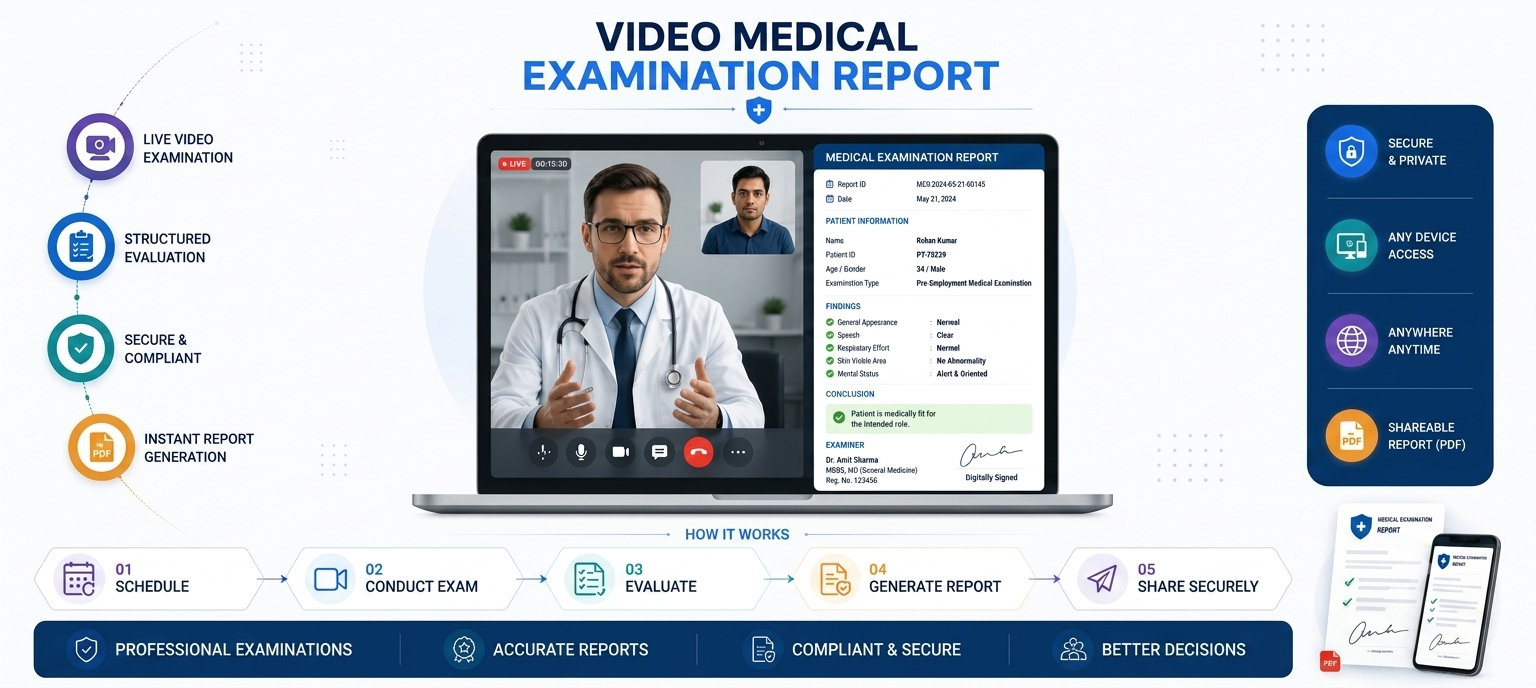
VMER — Video Medical Examination Report — solves this problem. A licensed doctor examines the applicant over a secure video call. The session is recorded. A proper digital report is generated and sent straight to the underwriting team. No travel. No delays. No lost paperwork.
This guide walks you through everything you need to know about VMER — how it works, why it matters, what the rules say, and how to pick the right platform.
What Is VMER (Video Medical Examination Report) in Life Insurance?
It is a medical examination done over video — not in person. A qualified, insurer-approved doctor connects with the applicant on a secure video platform, carries out the exam, and produces a standardised digital report that goes directly to the underwriting team.
This replaces the traditional Medical Examination Report (MER), which required applicants to visit a diagnostic centre, get examined, and wait for a paper or scanned report to slowly make its way to the insurer.
VMER does the exact same job — just faster, cheaper, and with a full video record of everything that happened.
It is also fully recognised under IRDAI's telemedicine and Video-Based Identification Process (VBIP) guidelines. Insurers using VMER are working within the rules — not around them.
How the VMER (Video Medical Examination Report) Process Works
Here is what the VMER process looks like from start to finish.
Step 1 — The Application Triggers a Medical Exam Request
When a term insurance application crosses the age or sum assured limit that requires a medical exam, the insurer or TPA sends a VMER request through the platform.
Step 2 — The Applicant Picks a Time Slot
The applicant gets a message — on WhatsApp, SMS, or email — to choose a convenient time for their video exam. No driving to a clinic. No waiting room.
Step 3 — A Doctor Is Assigned
An approved, insurer-empanelled doctor is matched to the case. They review the proposal form and any health conditions the applicant has declared before the session starts.
Step 4 — The Video Examination Happens
The applicant and doctor connect on a secure, recorded video call. The doctor follows the insurer's examination checklist — covering BMI, blood pressure, medical history, lifestyle habits, and any other required checks. The entire session is recorded.
Step 5 — The Digital Report Is Generated
Once the session is done, the platform automatically creates a standardised report in the insurer's own format. The doctor signs it, the system timestamps it, and it is sent to the underwriting desk — usually within 24 to 48 hours. For healthcare organisations looking to go further, AI-assisted clinical documentation can help structure clinical notes before they reach this report stage.
Step 6 — The Underwriter Reviews and Decides
The underwriter gets a clean, complete digital report. No chasing missing attachments. No re-entering data. Just a decision.
Top Benefits of VMER for Life Insurance Companies
The move from physical to video medical exams is not just about saving money. It is about writing more policies, reducing fraud, and building a better applicant experience.
1. Reach Applicants Anywhere
India has over 650 districts. Approved diagnostic centres are mostly concentrated in bigger cities. For applicants in smaller towns, a physical MER means a long journey and a long wait.
VMER removes this problem entirely. Any applicant with a smartphone can complete their exam — from their home, their workplace, or a nearby clinic. For insurers targeting Tier-2 and Tier-3 markets, this opens up business that was previously impossible to convert.
2. Cut Turnaround Time Dramatically
A physical MER takes 7 to 21 days from examination to report delivery. VMER does it in 24 to 48 hours.
That speed matters. Policies that used to take three weeks to issue now take three days. Applicants who might have dropped off during a long wait are onboarded before they change their minds.
3. Reduce Fraud Risk
With a physical exam, there is no independent record of what happened in the room. The insurer gets a signed form — nothing more. This creates a well-known fraud risk, especially for high-value term policies where undisclosed health conditions can be hidden.
Video Medical Examination records everything. If a claim is disputed later, the underwriter can replay the exact examination. Fraud investigation teams have real evidence, not just paperwork. BCG's 2025 report found that India's health insurance sector loses an estimated ₹8,000–10,000 crore every year to fraud, waste, and abuse. Recorded video exams directly address one of the biggest gaps in that chain. Insurers who want to go further can use claims and billing analytics to spot unusual patterns across their entire book — not just at the exam stage.
4. Get Consistent, Standardised Reports
Physical MER reports look different depending on which diagnostic centre produced them. Different layouts, different fields, different levels of detail. Underwriters spend time chasing clarifications and reconciling gaps.
VMER platforms generate every report from the insurer's own template. Every required field is filled before the doctor can submit. Reports are consistent every single time.
5. Lower Cost Per Case
Physical exams come with diagnostic centre fees, courier costs, and processing overhead. VMER replaces all of that with a single platform fee per examination — typically at a lower total cost, and with a faster, more auditable result.
How VMER Simplifies Medical Exams for NRI and GCC Life Insurance Applicants
Selling life insurance to Indians living in the Gulf is a good business opportunity. But getting a physical medical exam done is a genuine problem — it means the applicant either flies back to India or finds a locally accepted diagnostic centre.
VMER fixes this completely. An NRI in Dubai or Riyadh schedules a video exam with an India-based, insurer-approved doctor. The session runs in their preferred language. The report reaches the underwriting team in India within 48 hours. The policy is issued without the applicant ever coming back to India for the process.
For insurers building their GCC distribution, VMER is the piece that makes digital sales actually work.
Essential Features of a VMER Platform for Insurance Underwriting
Not every video call tool qualifies as a VMER platform. If a vendor is just offering a standard teleconsultation app with an insurance label on it, that is not good enough. Here is what a proper VMER platform must have.
Identity Verification
The applicant's identity must be confirmed before the exam starts — via Aadhaar, PAN, or a government-issued document shown on camera. Without this, the fraud-prevention value of the whole process is undermined.
Full Session Recording
Every session must be recorded, encrypted, and stored securely. If someone can access and alter a recording, the audit trail is worthless. Ask vendors exactly how and where they store recordings — and for how long.
Doctor Network, Not a Random Pool
Doctors must be formally approved by the insurer — not pulled from a general teleconsultation pool. The vendor needs to support insurer panel onboarding and verify that every doctor is registered under the Medical Council of India (NMC).
Insurer-Specific Report Templates
The platform must generate reports in the insurer's own format — not a generic form. Different product lines and sum assured bands may need different templates. If the vendor cannot support this, staff will end up reformatting reports manually, which defeats the purpose.
Direct Integration With Downstream Systems
The report must land directly in the insurer's underwriting system or TPA portal — not as a PDF attachment in an email. PDF delivery means someone has to re-key the data, which introduces errors and kills the speed advantage. Healthcare organisations managing multiple systems that do not talk to each other can address this through healthcare integration and custom development — covering ABDM, FHIR, HL7, and third-party API connections.
Audit Trails and MIS Reports
The platform should produce case-level logs and panel-level performance reports — showing which doctors are completing sessions on time, which have unusual approval rates, and where the process is slowing down. This data should be available without manual extraction.
How VMER Integrates with Insurance Underwriting and Claims Workflows
VMER works best when it is not an isolated tool. A standalone VMER module that emails a PDF to underwriting solves one problem — speed. A VMER platform connected to the full insurance workflow solves the entire chain.
When the VMER report feeds into a connected system, it:
- Generates claim documentation automatically — from verified VMER data, not manual data entry
- Triggers verification checklists — VMER completion automatically kicks off the next step
- Updates the case dashboard in real time — the insurer, TPA, and hospital all see current case status without anyone making phone calls
- Becomes searchable audit evidence — accessible directly from the claim file when needed later
CSoft VMER for Insurance is built as this kind of connected system — linking scheduling, video examination, digital report generation, and downstream workflows in one place. It also includes RCM automation, so billing, claim preparation, and denial follow-up all flow from the same data captured at the VMER stage — with no re-entry required.
How Hospitals Can Use Existing Telemedicine Infrastructure for VMER
If a hospital already has a telemedicine platform running for clinical consultations, it is already most of the way there for VMER. The video infrastructure, the doctor scheduling system, and the patient communication layer are all in place. Adding VMER for insurance assessments is a configuration and empanelment exercise — not a new technology build.
For Tier-2 hospitals that want to become local hubs for insurance assessments, this is a practical revenue opportunity. VMER volumes are predictable and repeatable. Each examination generates per-case revenue, and for hospitals already running RCM workflows, the billing cycle picks up naturally from the VMER data.
VMER vs Physical Medical Examination Report: Key Differences
Here is how the two methods compare across the dimensions that matter most to underwriters and TPA managers.
Scheduling and Turnaround Time
A physical MER involves travel, waiting for centre availability, and a slow report delivery chain. From request to report, it typically takes 7 to 21 days. VMER compresses this to 24 to 72 hours for scheduling and 24 to 48 hours for the report — because the applicant books a slot on their phone and the report is auto-generated the moment the session ends.
Geographic Reach
Physical MER only works where approved centres exist. VMER works anywhere with a smartphone and an internet connection — a Tier-3 town in Chhattisgarh or an NRI household in Sharjah. For insurers expanding into new markets, VMER is what makes those markets reachable.
Applicant Drop-Off
Every extra day in the application process is a day the applicant might walk away. A three-week physical MER window is a three-week cancellation risk. VMER closes most examinations within 48 hours — before the applicant's attention moves on.
Fraud Risk and Audit Evidence
In a physical exam, there is no recording, no witness, and no independent evidence of what happened. This is a documented fraud risk. VMER records every session in full. If a claim is disputed, the video is there. Every statement the applicant made, every response the doctor recorded — all of it is stored and retrievable.
Report Consistency
Physical MER reports vary by centre and form version. VMER reports are generated from the insurer's own template every time. Mandatory fields are enforced before submission. No gaps, no reconciliation work.
System Integration
Physical MER output arrives as a physical form, a scan, or a PDF. Someone re-keys the data. VMER pushes structured data directly into the underwriting system via API — no re-entry, no transcription errors, no delays.
NRI and GCC Access
Physical MER for NRI applicants is not practical without them returning to India. VMER removes this barrier completely. The session runs remotely, the report is delivered digitally, and the policy is issued without the applicant leaving their country.
Where physical MER still applies: For complex cases — conditions that require hands-on clinical assessment, specialist tests, or high-acuity evaluation — an in-person exam is still appropriate. VMER is built for standard underwriting cases where the bottleneck is logistics, not clinical judgment.
IRDAI Guidelines for VMER (Video Medical Examination Report)
One of the first questions insurers ask is whether VMER is compliant. The answer is yes — and the regulatory framework supporting it has only grown stronger since 2020.
Telemedicine Guidelines (2020)
IRDAI's telemedicine guidelines set the rules for technology-enabled medical assessments in insurance. VMER operates under these guidelines, which require a registered doctor, verified patient identity, and a documented record of the interaction.
Video-Based Identification Process — VBIP (2020)
The VBIP circular formalised video-based identity verification for insurance processes. This directly governs the identity check that every compliant VMER platform must carry out before the exam begins.
Insurance Fraud Monitoring Framework Guidelines (2025)
The 2025 guidelines require insurers to maintain clear, documented evidence trails at the underwriting stage. A timestamped, stored VMER recording satisfies this requirement. A scanned paper MER does not.
Master Circular on Life Insurance Products (June 2024)
This circular reaffirms the digital-first direction for insurance distribution and underwriting — supporting the insurer SOPs that formally accept VMER as a valid examination method.
A Note on Insurer SOPs
Regulatory guidelines create the space. Whether VMER is accepted for a specific product and sum assured band depends on the insurer's internal underwriting SOP. Most leading private life insurers in India have updated their SOPs to accept VMER for standard term and endowment policies. Compliance teams should confirm this in writing with each insurer partner before going live.
The trend is clear: IRDAI has consistently expanded digital permissions since 2020. No circular has reversed course. Insurers investing in VMER today are building on a framework that is likely to widen, not shrink.
How to Choose the Best VMER Platform for Insurance Companies
A video call with a doctor is not VMER. A generic teleconsultation app is not VMER. When evaluating platforms, check these eight things before signing anything.
1. Does it verify identity before the session starts?
Aadhaar, PAN, or a government-issued document must be confirmed on camera before the exam begins. No verification = no fraud protection.
2. Does it record the full session?
Partial recordings are useless for audit. The full session must be encrypted, stored securely, and retrievable by the insurer. Ask where recordings are stored and for how long.
3. Can it generate insurer-specific report templates?
The report must match your insurer's exact format. If the platform only produces a generic report, your team will spend time reformatting it — and you have lost the efficiency gain.
4. Is the doctor panel insurer-approved?
Doctors must be formally empanelled by the insurer — not sourced from a general doctor pool. Confirm the vendor supports insurer panel onboarding and that all doctors are registered with the NMC.
5. Does it integrate directly with your systems?
The report must push into your underwriting system or TPA portal via API — not land in an email as a PDF. If there is manual data entry involved, the platform is not truly integrated.
6. Does it handle scheduling end to end?
Applicant communication, doctor availability, slot booking, and rescheduling should all be managed by the platform. If your team is doing this manually, you still have operational overhead.
7. Does it produce audit trails and MIS reports?
You need case-level logs and panel-level performance data. Examination volumes, completion rates, turnaround times, and doctor-level anomalies should all be surfaced automatically — not extracted manually at month end.
8. Can the vendor show IRDAI compliance documentation?
Any vendor worth working with should be able to produce written evidence of how their platform meets IRDAI's telemedicine and VBIP guidelines. If they cannot, that is a clear warning sign.
Where Things Are Heading
The question in 2026 is not whether VMER works. It does. The question is how fast insurers can shift the remaining in-person exam volume onto video.
The market is already moving. Leading private life insurers have accepted VMER for standard underwriting bands. GCC distributors are making it a condition of digital channel partnerships. IRDAI's direction is clearly toward more digital, not less.
For insurers, TPAs, and hospitals deciding where to invest in digital underwriting infrastructure, VMER is not a future capability. It is the current standard that separates teams closing policies in two days from teams still waiting on couriered paper forms.
Let's Modernise Your Insurance Medical Examination Process
As insurers move towards faster, digital underwriting, implementing VMER requires a platform built for compliance, operational efficiency, and seamless integration. From identity verification and recorded video assessments to standardised medical reports and underwriting workflows, every step should work together in a secure, auditable process.