
It is 9:15 on a Monday morning.
The front desk at a 200-bed hospital in Bengaluru has already answered 43 calls — and the day has barely started. Most callers are asking the same three questions:
- Is the doctor available today?
- When will my report be ready?
- Can I reschedule my appointment?
Two staff members are stuck on the phone. A queue of patients is waiting at the counter. Billing queries are piling up. And somewhere in the middle of all this, an urgent call is sitting on hold.
The medical director has one simple question: Why are we paying skilled people to repeat the same answers a machine could give in five seconds?
This is not a staffing problem. It is a process problem.
In 2026, hospitals across India are solving it with voice AI agents — systems that handle routine patient calls automatically, around the clock, in the patient's own language, connected to the hospital's live data.
What Exactly Is a Voice AI Agent?
Think of a voice AI agent as a smart phone assistant that works for your hospital.
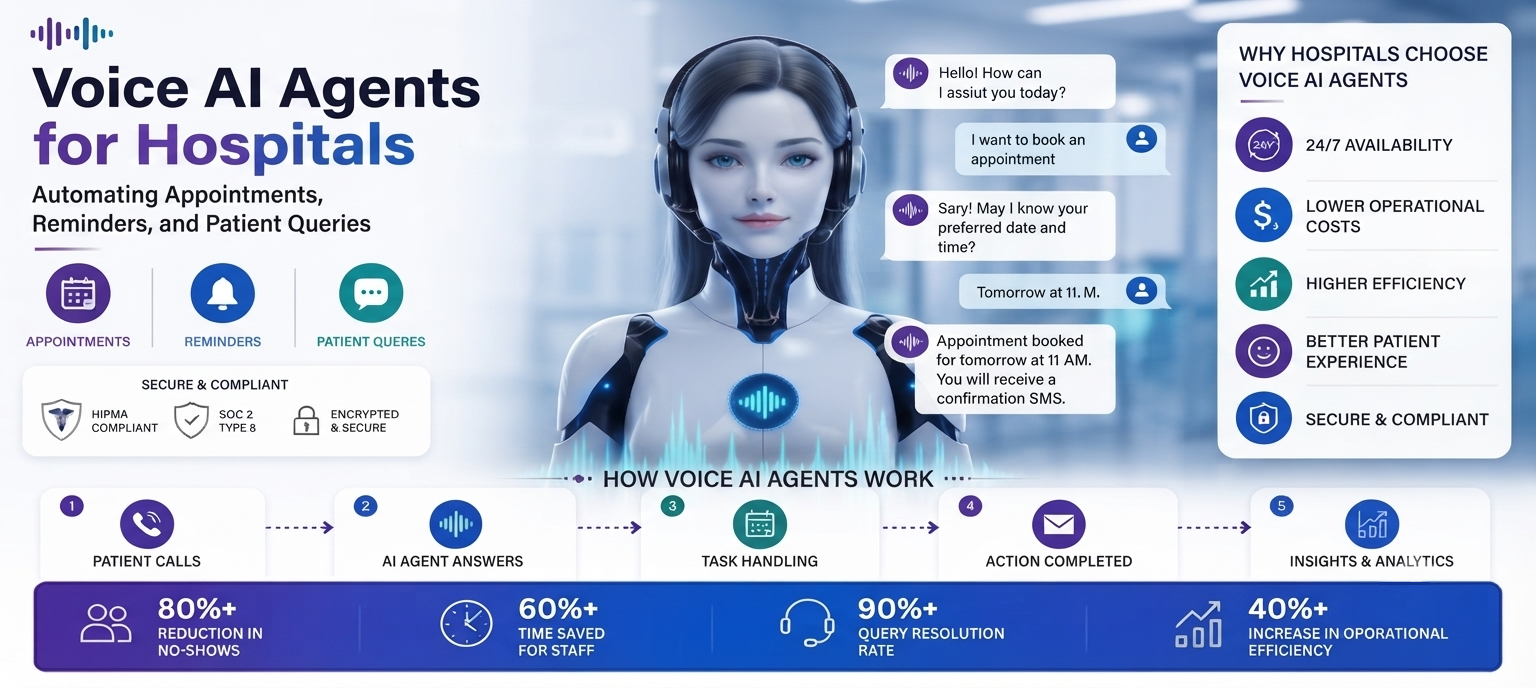
It picks up calls, understands what the patient is saying, and completes the task — booking an appointment, sending a reminder, checking a lab report status — without putting anyone on hold.
It is nothing like the old "press 1 for appointments, press 2 for billing" IVR systems. Those are menu trees that frustrate people. A voice AI agent actually listens, understands, and responds like a person would.
The key difference is connection. A good voice agent is plugged into your hospital's live scheduling system, patient records, and lab database. So when a patient asks about an appointment, the agent sees your actual calendar — not a static list that went out of date three hours ago.
Why Hospitals Are Adopting Voice AI
Hospitals receive hundreds of patient calls every day. Front-desk staff spend a lot of time answering common questions about appointments, doctor availability, lab reports, insurance, and hospital services.
Voice AI helps by handling these routine conversations automatically, allowing staff to focus on patient care while providing faster support to patients.
Common Challenges
- Long call wait times
- Missed patient calls
- Delayed responses during busy hours
- Staff spending too much time on repetitive enquiries
How Voice AI Helps
- Answers common patient questions automatically
- Books and confirms appointments
- Sends appointment reminders
- Provides 24/7 patient support
- Reduces workload for front-desk teams
Benefits for Hospitals
- Faster patient communication
- Fewer missed appointments
- Less administrative work
- Better patient experience
- More time for staff to focus on patient care
What Can a Voice Agent Actually Do?
Here is what hospitals are using voice AI for right now.
Booking and rescheduling appointments
A patient calls, says they want an appointment with Dr. Rao on Thursday, and the agent checks live availability, confirms a slot, and sends a confirmation message — all in under two minutes. No hold music. No callback.
Outbound reminder calls
Instead of a staff member manually calling 200 patients the evening before clinic day, the voice agent calls all of them automatically. It confirms the appointment, reminds them what to bring, and flags any cancellations so the slot can go to someone else.
Pre-visit instructions
Fasting rules. Documents to carry. Which entrance to use. What time to arrive for a day-care procedure. The agent tells each patient exactly what they need to know before they leave home.
Lab report alerts
When a lab result is ready, the agent calls the patient. No more patients calling five times a day to ask "is my report done yet?"
Common patient questions
OPD timings, visiting hours, parking, insurance empanelment, department locations — the agent answers all of these without involving your staff.
After-hours support
Routine calls do not stop when your front desk goes home at 6 PM. A voice agent handles bookings, queries, and reminders around the clock. Nothing falls through the gap overnight.
Routing complex calls
When a question is genuinely complicated — a billing dispute, a clinical concern — the agent transfers the call to the right person, with context, so the patient does not have to repeat everything.
Why Language Matters More Than Anything
A voice agent that only speaks textbook English will fail in most Indian hospitals. It is as simple as that.
Your patients are not going to rephrase their question in standard English for a bot. An elderly patient from Mysuru is going to say "kal subah ka appointment chahiye." A patient in Chennai will speak in Tamil. Someone from Pune will mix Marathi and Hindi in the same sentence.
If the agent does not understand that — the call fails. And a failed call is worse than no automation, because now the patient is frustrated on top of being unserved.
Good hospital voice agents in India handle:
- Hindi and major regional languages — Kannada, Tamil, Telugu, Marathi, Malayalam, Bengali
- Code-switching — because real patients say "Friday ko 11 baje ka slot milega kya?" not "I would like to book an appointment for Friday at 11 AM"
- Local accents and informal phrasing — not just the textbook version of each language
Before going live with any voice AI, run a live demo in your patients' primary language — not a scripted one. Have someone speak naturally, informally, the way your patients actually call. If the agent handles it well, it will work. If it stumbles, fix that before going live.
Results Hospitals Are Seeing
Hospitals implementing Voice AI are seeing measurable improvements in operational efficiency, patient communication, and front-desk productivity. The results vary based on hospital size, patient volume, workflows, and implementation, but the most common benefits include:
40% reduction in appointment no-shows after consistent automated reminder calls replace manual outbound calling.
40–60% of inbound call volume deflected by the voice agent end to end — no staff involvement, no hold time, task completed.
24/7 availability for bookings, queries, and reminders — without any increase in staffing cost.
2–4 staff hours saved per day per front-desk employee — time that shifts from call management to patient-facing care.
Readmission rates drop at hospitals running structured discharge follow-up calls — because patients actually follow post-discharge instructions when someone calls to walk them through it.
For a mid-sized hospital running 500 OPD appointments a day, even a 10-percentage-point improvement in no-show rates recovers roughly ₹54 lakh per year — from one use case, in one department.
Why HIMS Integration Matters
A Voice AI agent is only effective when it is connected to your Hospital Information Management System (HIMS). Without real-time access to appointments, patient records, and other hospital data, it can provide incorrect information or create scheduling conflicts.
With HIMS integration, the Voice AI agent can:
- Check live doctor schedules and appointment availability.
- Book, reschedule, or cancel appointments instantly.
- Access patient information securely.
- Share approved updates such as lab report status.
- Send appointment reminders and follow-up notifications.
- Update hospital records in real time.
When connected to HIMS, a Voice AI agent becomes more than a call-answering system. It helps hospitals deliver faster, more accurate, and seamless patient service while reducing the workload on front-desk staff.
How CSoft Delivers Connected Voice AI
CSoft Voice Agents integrate seamlessly with CSoft HIMS, ensuring appointments, cancellations, and schedule updates are reflected instantly across the hospital. The platform also connects with CSoft Telemedicine to send automated appointment reminders and secure video consultation links.
In addition, every Voice AI interaction generates structured data that can be used with CSoft RCM Automation and CSoft Fraud Analytics to improve billing workflows, monitor patient interactions, and enhance operational efficiency.
Is Voice AI Secure for Hospitals?
Yes, Voice AI can be secure when it is built with the right security and privacy controls. Hospitals should choose a solution that protects patient information while allowing staff to deliver fast and efficient service.
A secure Voice AI platform should:
- Connect safely with your HIMS and other hospital systems.
- Protect patient data with encryption.
- Restrict access using role-based permissions.
- Keep audit logs of all system activities.
- Follow your hospital's security and privacy policies.
It is also important to decide which requests the Voice AI agent can handle and which should be transferred to hospital staff. This ensures sensitive conversations are managed by the right people.
With a secure and well-integrated platform, hospitals can improve patient communication while keeping health information safe and protected.
How to Get Started with Voice AI
The best way to start with voice AI is to automate one task first instead of trying to automate everything. This helps your hospital see results quickly and makes it easier for staff to adapt.
For most hospitals, appointment reminder calls are the best place to start. Use the voice agent to remind patients about their appointments, then track the results for a few weeks before expanding to other departments.
Key Metrics to Track
- Call Handling: How many patient calls are completed without staff support?
- No-show Rate: Are fewer patients missing their appointments?
- Call Success Rate: How many calls end with a confirmed appointment, rescheduled visit, or answered question?
- Time Saved: How much time has your front desk saved on reminder calls?
- Patient Feedback: Ask patients if the automated call was helpful.
Once you see good results, you can gradually use voice AI for more services across your hospital.
How to Choose the Right Voice AI Platform
Before choosing a Voice AI platform, make sure it meets your hospital's day-to-day needs.
- Real-Time HIMS Integration: The platform should connect to your live doctor schedules and appointment system to avoid booking conflicts.
- Multilingual Support: It should communicate naturally in English, Hindi, and the regional languages your patients speak.
- Easy Transfer to Staff: If the voice agent cannot solve a request, it should transfer the call to a staff member along with the conversation details, so patients do not have to repeat themselves.
- Handles Real Conversations: Patients do not always speak in a fixed way. The voice agent should understand different questions, unclear responses, and changes in conversation without getting confused.
- Fits Your Hospital Workflow: The platform should adapt to your appointment rules, departments, and hospital processes instead of forcing you to change how you work.
- Reports and Insights: Look for a platform that provides call reports, success rates, transfer reasons, and common patient queries. These insights help improve service and measure performance.
Choosing the right Voice AI platform means selecting a solution that works with your existing hospital systems, supports your staff, and delivers a better experience for patients.
The Future of Patient Communication Starts with Smarter Conversations
Voice AI helps hospitals automate routine calls, improve patient communication, and reduce administrative workload. By integrating with HIMS and expanding step by step, hospitals can deliver faster, more efficient, and better patient service.