
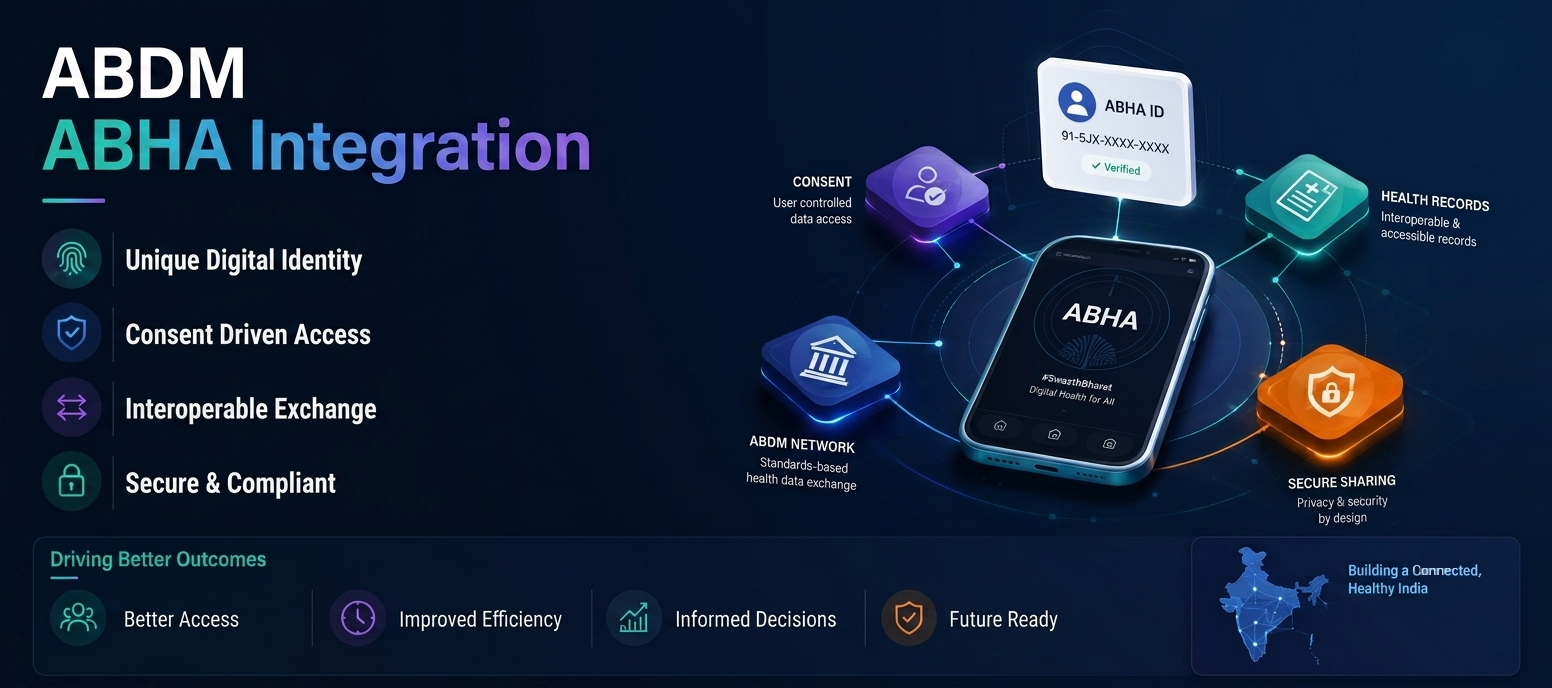
ABDM ABHA integration is becoming essential for Indian hospitals. It helps healthcare providers connect with the national digital health ecosystem, improve patient record sharing, and meet growing compliance requirements.
This guide explains everything hospitals need to know about ABDM ABHA integration in 2026, including FHIR standards, ABHA linking, interoperability requirements, the key compliance modules, and a step-by-step implementation process. It also covers how hospitals can achieve ABDM compliance while continuing to use their hospital information management system, existing HIMS platform.
What Is ABDM (Ayushman Bharat Digital Mission)?
The Ayushman Bharat Digital Mission (ABDM) is India's national program for building a connected digital healthcare ecosystem. Launched by the National Health Authority (NHA), it enables secure and standardized health data exchange across the country.
ABDM aims to provide:
- ABHA IDs for unique patient identification.
- Interoperable health records that can be shared across hospitals, labs, and pharmacies.
- Patient consent-based data sharing for better privacy and control.
- Verified registries of healthcare facilities and professionals.
Today, ABDM compliance is becoming increasingly important for hospitals. It supports participation in government healthcare schemes, improves data sharing, and helps hospitals connect with India's growing digital health network.
Key ABDM Milestones for Hospitals
To become ABDM-compliant, hospitals need to complete several important steps:
- Health Facility Registry (HFR): Register the hospital on the ABDM network as a verified healthcare facility.
- Health Professional Registry (HPR): Link doctors and healthcare professionals to the national registry.
- ABHA Creation and Linking: Enable patients to create and link their ABHA IDs with hospital records and EMR systems.
- Consent-Based Record Sharing: Allow patients to securely share their health records through the ABDM consent framework.
- FHIR Compliance: Structure health data using FHIR standards to support seamless and standardized information exchange across healthcare systems.
Completing these milestones helps hospitals improve interoperability, strengthen compliance, and participate fully in India's digital health ecosystem.
The Three ABDM Integration Modules
ABDM compliance is divided into three key modules. Hospitals must complete all three to achieve full ABDM integration.
Module 1 (M1): HPR Integration
This module focuses on the Health Professional Registry (HPR). Hospitals must verify and link doctors and healthcare professionals to their HIMS using HPR records, ensuring authenticated practitioner identities.
Module 2 (M2): HFR Integration
This module covers the Health Facility Registry (HFR). Hospitals register their facility details, receive an HFR ID, and become part of the ABDM network for secure health data exchange.
Module 3 (M3): Health Records and Consent Management
This is the most important module and includes:
- ABHA ID creation and verification.
- Patient consent management for data sharing.
- FHIR-compliant health record creation.
- Secure, encrypted data exchange.
- Health Information Exchange (HIE) through the ABDM network.
While M1 and M2 establish hospital and practitioner identities, M3 enables actual health record sharing and interoperability, delivering the full benefits of ABDM.
ABDM Integration Step-by-Step for Hospitals in 2026
Step 1: Register on the ABDM Sandbox
Create a developer account on the ABDM Sandbox and obtain API credentials. This testing environment allows hospitals and software vendors to validate integrations before going live.
Step 2: Complete HFR Registration
Register your hospital in the Health Facility Registry (HFR) and obtain a unique HFR ID. This identifies your facility within the ABDM ecosystem.
Step 3: Implement HPR Integration
Connect your HIMS with the Health Professional Registry (HPR) to verify and link doctors using their medical council registration details.
Step 4: Enable ABHA Linking
Integrate ABHA ID creation and verification into patient registration. Patients should be able to create or link their ABHA IDs during registration for seamless digital record management.
Step 5: Configure Consent Management and FHIR Mapping
Implement the ABDM consent framework and map EMR data such as prescriptions, lab reports, and discharge summaries into FHIR-compliant formats for secure record sharing.
Step 6: Testing and Certification
Test all integrations in the ABDM Sandbox, including ABHA workflows, consent management, FHIR data exchange, and security requirements. After successful validation, your hospital can move to production and become fully ABDM-compliant.
Following these steps helps hospitals achieve interoperability, improve patient data exchange, and participate in India's national digital health ecosystem.
Building ABDM integration from scratch typically takes 3–6 months of development. Using a pre-integrated or interoperability-layer solution can compress this to weeks.
Technical Requirements for ABDM Compliance
Before starting ABDM certification, hospitals should ensure their HIMS platform supports the following technical requirements:
- FHIR R4: Used for standardized and structured health record exchange across healthcare systems.
- OAuth 2.0 Authentication: Provides secure access to ABDM APIs and connected applications.
- TLS 1.2 or Higher: Ensures all health data is encrypted while being transmitted between systems.
- AES-256 Encryption: Protects patient records and sensitive healthcare data stored within the system.
- JWT Tokens: Enables secure API authorization and session-based access control.
- ABDM Consent Manager Framework: Supports patient-controlled consent for sharing health records with other healthcare providers.
- ABHA APIs: Used to create, verify, and link ABHA IDs for accurate patient identification.
Hospitals should confirm that their HIMS vendor or integration partner meets these requirements before beginning the ABDM production certification process.
Integration Without Rip-and-Replace
Most hospitals do not need to replace their entire Hospital Information Management System to become ABDM-compliant. Existing systems often contain years of patient data, custom workflows, and reports that are costly and risky to replace — which is why choosing the right HIMS matters before starting any integration.
Instead, hospitals can use an interoperability layer that connects their current HIMS, laboratory, and pharmacy systems to ABDM APIs. This enables ABHA linking, consent management, FHIR-compliant data exchange, and secure health record sharing without disrupting daily operations.
"We created ABHA IDs at admission. But until records could move with consent, we were compliant on paper and empty in practice." — Health informatics lead, 300-bed hospital, Rajasthan
CSoft Interoperability Hub is designed for this purpose. It connects existing healthcare systems to the ABDM network, supports ABHA integration and consent management, and enables seamless health information exchange. Hospitals can achieve ABDM compliance while continuing to use the systems they already rely on.
Business Benefits Beyond Compliance
ABDM integration is more than a regulatory requirement. It also delivers practical benefits that improve hospital operations and patient care.
- Faster Referrals and Second Opinions: Doctors can access patient records digitally with consent, helping them make informed decisions more quickly.
- Reduced Duplicate Tests: Previous lab reports and medical records can be shared securely, reducing unnecessary repeat investigations and lowering costs for patients.
- Better Audit and Compliance Tracking: Consent records and digital health data create clear audit trails — a practice that directly supports NABH compliance and quality assurance.
- Government Scheme Eligibility: ABDM compliance helps hospitals participate in programs such as PM-JAY, and when combined with RCM automation, it significantly speeds up claim processing and reimbursements.
- Improved Patient Experience: Patients can access and share their digital health records more easily, supporting a modern and connected healthcare experience.
Beyond compliance, ABDM integration helps hospitals improve efficiency, strengthen data sharing, and prepare for the future of digital healthcare in India.
Get ABDM-Ready with CSoft Solutions
Whether you're starting your ABDM journey or expanding existing digital health capabilities, CSoft provides the expertise, implementation support, and guidance needed to achieve compliance faster while minimizing disruption to hospital operations.